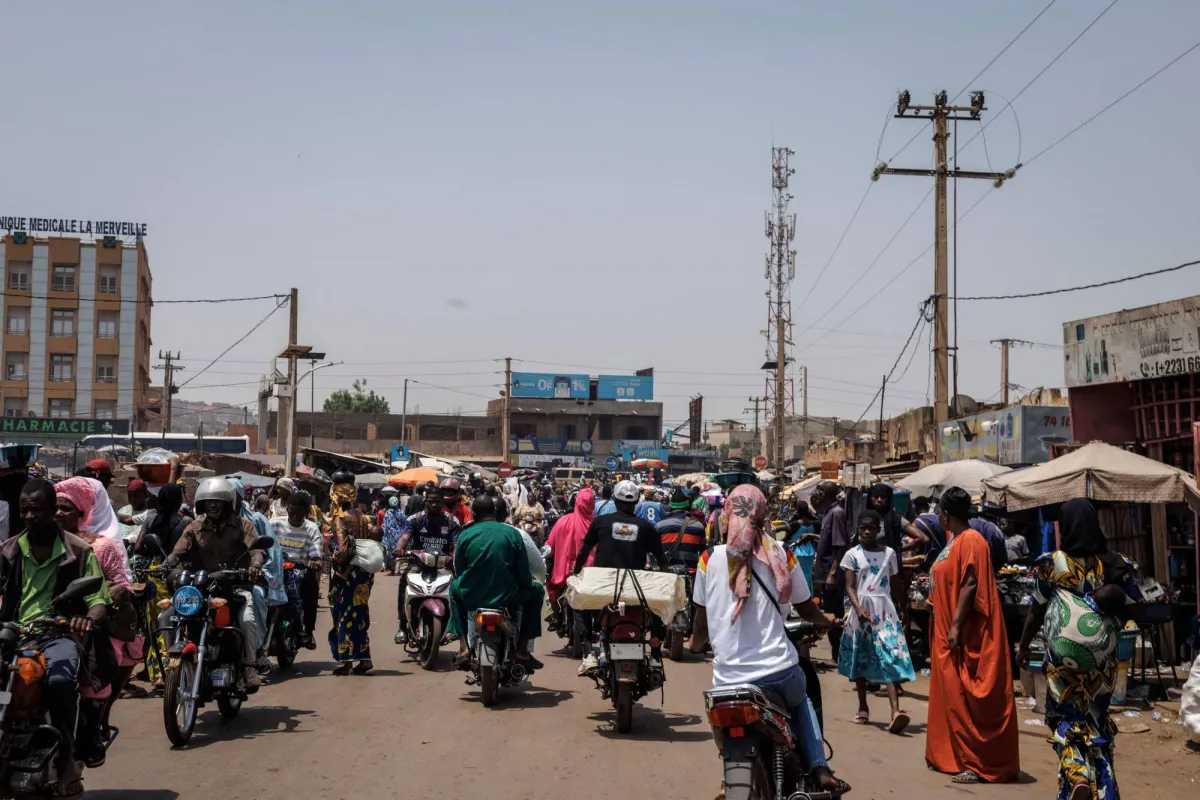
Powerful explosions erupted around Bamako International Airport late Monday to Tuesday, breaking the cautious calm that had prevailed in the city and its surroundings throughout Monday, following coordinated terrorist attacks and clashes between the military and 'Al-Qaeda' fighters over the weekend.
Local residents reported that at least two strong explosions occurred near the airport before calm returned to the area, with no information released regarding the nature of these explosions. Military helicopters were later seen flying over the region.
Details of the Incident
A reporter from the 'Agence France-Presse' in Bamako noted that prior to the explosions, a convoy of pickup trucks and military transport vehicles was seen speeding towards the airport, while a military aircraft briefly flew over the area.
The Sino neighborhood, where the airport and sensitive military sites are located, was the scene of violent clashes on Saturday between the Malian army and fighters from the 'Nusra Front,' affiliated with the terrorist organization 'Al-Qaeda,' who are allied with Tuareg rebels under the 'Azawad Liberation Front.' Defense Minister Sadio Kamara was killed in these clashes, while President Assimi Goita and the head of intelligence remain out of sight, amid doubts and rumors regarding their fate.
For the first time since the terrorist attacks that struck sensitive sites in Bamako, Malian Prime Minister Abdoulaye Maiga appeared to visit several injured individuals in the hospital before holding a press conference where he affirmed his country's determination to 'eradicate terrorism.' Maiga stated that his government is committed to continuing the fight against terrorism, adding that 'fear has no place here,' and urged the Malian people to rally behind state institutions and the armed forces in their war against terrorism.
Context and Background
Maiga accused unnamed 'foreign entities' of supporting the terrorists in the large-scale attack that targeted the capital Bamako and several cities simultaneously. He considered that these attacks aimed to instill terror, undermine national cohesion, and weaken transitional government institutions. However, Maiga announced that 'the reaction of the Malian armed forces managed to neutralize hundreds of terrorists,' confirming that the armed groups 'failed to achieve their objectives.'
Earlier on Monday, the Malian army announced that it had managed to neutralize over 200 terrorists while responding to the attacks, stating in a statement that it 'neutralized more than 200 terrorists and seized large quantities of weapons,' before describing its response to the simultaneous and powerful terrorist attacks as 'appropriate and proportional.'
Impact and Consequences
The army clarified that it conducted military operations in most targeted areas, particularly in the capital Bamako and the cities of Gao, Sévaré, and Mopti, without any indication of targeting the city of Kidal, in the far north of the country, which is under the control of Tuareg rebels. The army warned against getting carried away by rumors and urged residents to 'remain calm and not get swept away' by misleading information, relying solely on official statements issued by the General Staff.
Additionally, local sources confirmed that 'Al-Qaeda' elements were moving on hundreds of motorcycles around the capital Bamako, having closed several national roads leading to the city, which has a population of over 3 million. These sources reported the closure of roads linking Bamako to the border with Mauritania and others connecting it to Côte d'Ivoire, amid fears of the road leading to Senegal being closed as well.
Regional Significance
Mali is a landlocked country, relying directly and daily on imports from neighboring countries through their ports, especially Senegal, Côte d'Ivoire, and Mauritania. France expressed its 'concern' following the attacks, condemning the violence perpetrated against civilians and expressing solidarity with the Malian people. France also urged its citizens in the region to exercise the utmost caution.
Conversely, the Kremlin avoided providing an assessment of the military situation in Mali, following reports about 'Russian Legion' groups from the Ministry of Defense being targeted in a concentrated attack by rebels that forced them to withdraw from northern regions of the country. In the absence of an official clarification from the Ministry of Defense regarding the developments, reports indicated that the presence of Russian forces in this country faced a strong jolt, which could threaten Moscow's growing influence on the African continent.
In conclusion, the situation in Mali remains complex, with local and international dimensions intertwining, making it difficult to predict the future of the country amid these ongoing crises.