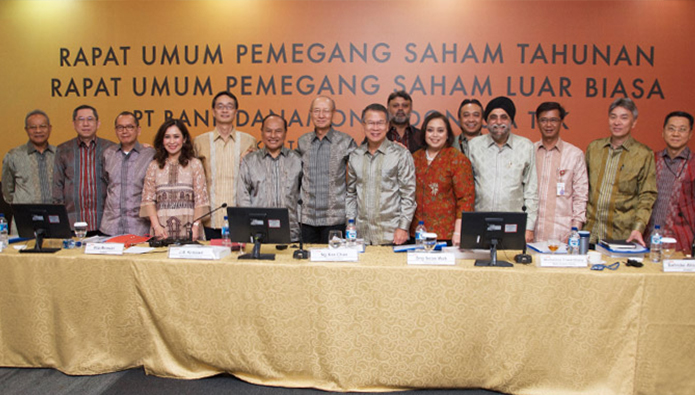
Indonesian Bank Danamon (BDMN) approved a dividend distribution of 1.4 trillion rupiah during the General Meeting of Shareholders held on Tuesday, March 31, for the fiscal year 2025, along with management changes. The meeting, which took place in Jakarta, witnessed shareholders' approval of all agenda items, reflecting the bank's commitment to implementing sound governance principles.
In a statement, Yasuhide Itagaki, the bank's chairman, confirmed that the General Meeting represents an important step towards enhancing transparency and accountability in the bank's management. He also noted that the dividend distribution reflects the bank's strong financial performance during the fiscal year 2025.
Event Details
The distributed dividend is set at 142.19 rupiah per share, representing 35% of the net profit after tax and minority interests, which totaled 4.0 trillion rupiah in the fiscal year 2025. Details regarding the payment of dividends will be announced later.
Additionally, the meeting saw changes in the management structure, as the terms of several board members ended without reappointment. Among those, Nobuya Kawasaki, who served as chairman, Peter Benjamin Stock as an independent member, and Daisuke Ejima as general manager.
Background & Context
Founded in 1956, Bank Danamon is considered one of the leading banks in Indonesia. Over the years, the bank has expanded its range of services to include a variety of financial products, including personal loans, corporate banking, and Islamic banking services. The bank has witnessed significant profit growth in recent years, reflecting its successful expansion strategies.
These management changes and the dividend distribution come at a critical time for the bank as it seeks to enhance a culture of sound governance and transparency across all its operations. These steps also reflect the bank's commitment to meeting the expectations of both shareholders and customers.
Impact & Consequences
These decisions are expected to positively influence investor confidence in the bank, as the dividend distribution reflects strong performance and sustainable profitability. Furthermore, the management changes may lead to renewed ideas and strategies, helping the bank adapt to future challenges.
These steps are also indicative of the overall trend in the Indonesian market towards enhancing sound governance, which could attract more foreign and domestic investments in the banking sector.
Regional Significance
The Arab region is witnessing increased interest in investing in Asian markets, particularly in Indonesia, which is one of the largest economies in Southeast Asia. These developments at Bank Danamon serve as a model for Arab banks seeking to enhance governance and transparency practices.
In light of global economic challenges, the successful experiences of Indonesian banks can inspire Arab banks to improve their performance and increase their attractiveness to investors.