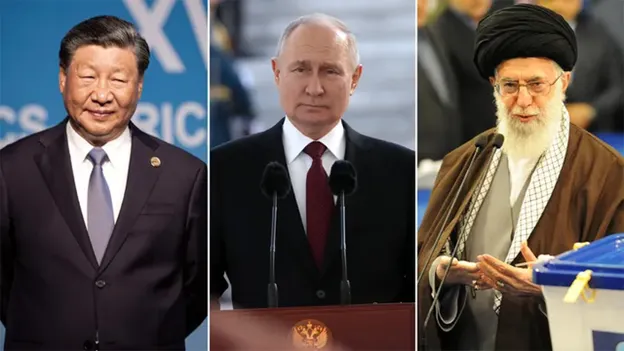
Iran is seeking to leverage Russian and Chinese governance models to enhance its regional influence amid ongoing challenges. This move follows statements from former U.S. President Donald Trump regarding 'regime change' in Iran, a concept that differs from its use in the context of the Iraq invasion by the George W. Bush administration in 2003.
These statements are part of a broader strategy aimed at undermining the Iranian regime, as international pressures on Tehran continue to mount. Trump indicated that regime change in Iran is part of his foreign policy, reflecting a renewed American perspective towards the Middle East.
Event Details
In recent years, Iran has witnessed a significant shift in its foreign policy, as it began to seek new governance models that align with its aspirations. The Russian model, which relies on centralized power and state strength, and the Chinese model, which focuses on economic development while maintaining political control, may be options available to Tehran.
Iran aims to benefit from the Russian and Chinese experiences in various fields, ranging from economics to foreign policy, to strengthen its position against Western pressures. This strategy could enhance Iran's ability to adapt to current challenges.
Background & Context
Since 2003, when the United States invaded Iraq, the concept of 'regime change' has become part of American political discourse. At that time, the occupation was justified by promoting democracy, but the results on the ground were catastrophic. Today, it appears that Trump seeks to replicate this scenario with Iran, raising questions about Washington's true intentions.
Historically, Iran has been under continuous international pressure, especially after the U.S. withdrawal from the nuclear agreement in 2018. This withdrawal led to heightened tensions between Tehran and Washington, prompting Iran to seek new allies, such as Russia and China, to bolster its position on the international stage.
Impact & Consequences
If Iran succeeds in implementing Russian and Chinese governance models, it could lead to radical changes in its domestic and foreign policies. These models may enhance Iran's capacity to confront international pressures, potentially exacerbating tensions in the region.
Furthermore, this strategy could impact Iran's relations with Arab countries, as some nations may feel concerned about the strengthening of Iran's influence in the region. This anxiety could lead to new alliances or additional tensions in regional relations.
Regional Significance
Iran is a key player in the Middle East, and any changes in its policies could directly affect Arab countries. If Iran successfully enhances the Russian and Chinese governance models, it could increase its influence in Iraq, Syria, and Lebanon, raising concerns among neighboring states.
These dynamics may also affect peace efforts in the region, as Arab nations may find themselves compelled to adapt to a new reality characterized by increased Iranian influence. Under these circumstances, Arab countries need to consider new strategies to address the challenges arising from these changes.
In conclusion, it seems that Iran is seeking to reshape its foreign policy by drawing inspiration from Russian and Chinese models. This trend could have wide-ranging implications for the region, necessitating careful monitoring by Arab nations and the international community.