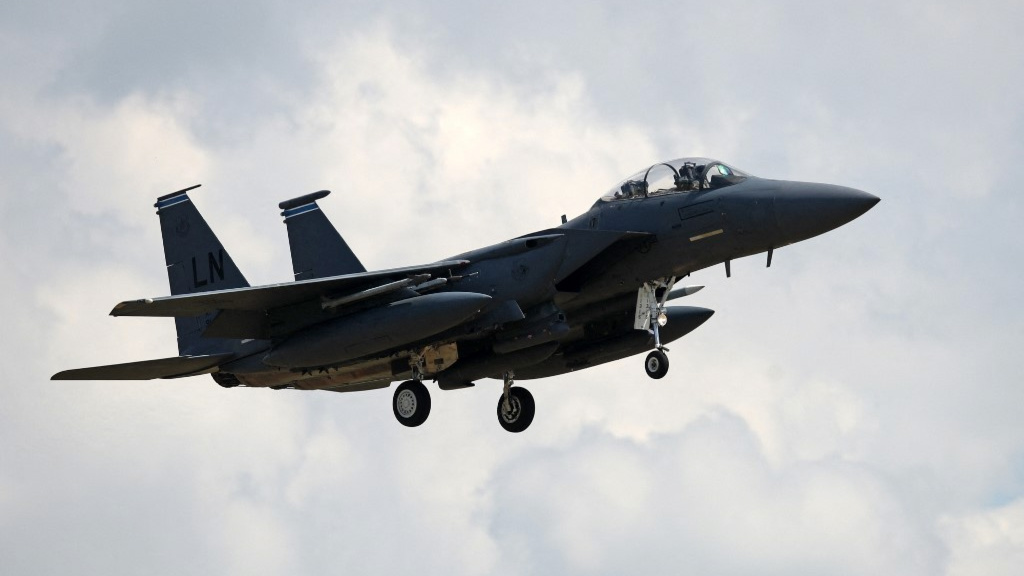
The Iranian Air Force (IRGC) reported that it shot down an F-35 fighter jet over central Iran, which belongs to the squadron stationed at the British RAF Lakenheath base. This incident highlights the increasing role that British military bases play in US military operations against Iran.
While the British Ministry of Defence has not commented on the incident, there has been no response from the Pentagon so far. The F-35, manufactured by Lockheed Martin, is one of the primary fighter jets used by the United States in its military operations, including the US-Israeli war against Iran.
Details of the Incident
In late March, the United States denied Iranian claims that the IRGC had shot down an F-35. However, an Iranian news agency published images showing the wreckage of the downed aircraft, which displays the tail code "LN" identifying it as part of the 48th Fighter Wing in the 493rd Squadron at Lakenheath.
RAF Lakenheath, owned by the British Ministry of Defence, is leased to the US Air Force and is the largest American fighter operation in Europe, hosting the 48th Fighter Wing. On March 24, five F-35C jets were spotted landing at Lakenheath, and on Monday evening, a group of 12 A-10C Thunderbolt II aircraft, known as "Warthogs," landed at the base.
Background & Context
Historically, the British base has been part of the US military strategy in Europe, serving as a platform for launching operations against targets in the Middle East. Since the onset of the US-Israeli war on Iran, the base has seen increased activity, raising concerns in Iran about the use of British bases as launch points for attacks.
On March 31, two EA-37B Compass Call aircraft, which are electronic warfare planes, were photographed landing at RAF Mildenhall, indicating a rise in US military activity in the region. The Iranian embassy in London also confirmed that Tehran is "considering" the possibility of targeting British bases as a form of retaliation against attacks.
Impact & Consequences
This incident could escalate tensions between Iran and Western countries, especially with the increasing US military activity in the region. The use of British bases as launch points for attacks may place the British government in a difficult position, as it could face pressure from Iran to respond to these activities.
At the same time, these developments could lead to heightened tensions in the Strait of Hormuz, a vital maritime corridor through which approximately 20% of the world's oil flows. British Foreign Secretary Yvette Cooper has expressed her rejection of any Iranian attempt to impose fees on ships passing through the strait, emphasizing the need to prevent Iran from "holding the global economy hostage."
Regional Significance
Arab countries are directly affected by these tensions, as any military escalation in the region could have negative impacts on security and stability. Additionally, Arab nations that rely on oil shipments through the Strait of Hormuz may face significant challenges if tensions continue.
In conclusion, this incident illustrates how tensions between Iran and the United States can impact regional security, prompting Arab nations to take clear stances to protect their interests amid these changing circumstances.