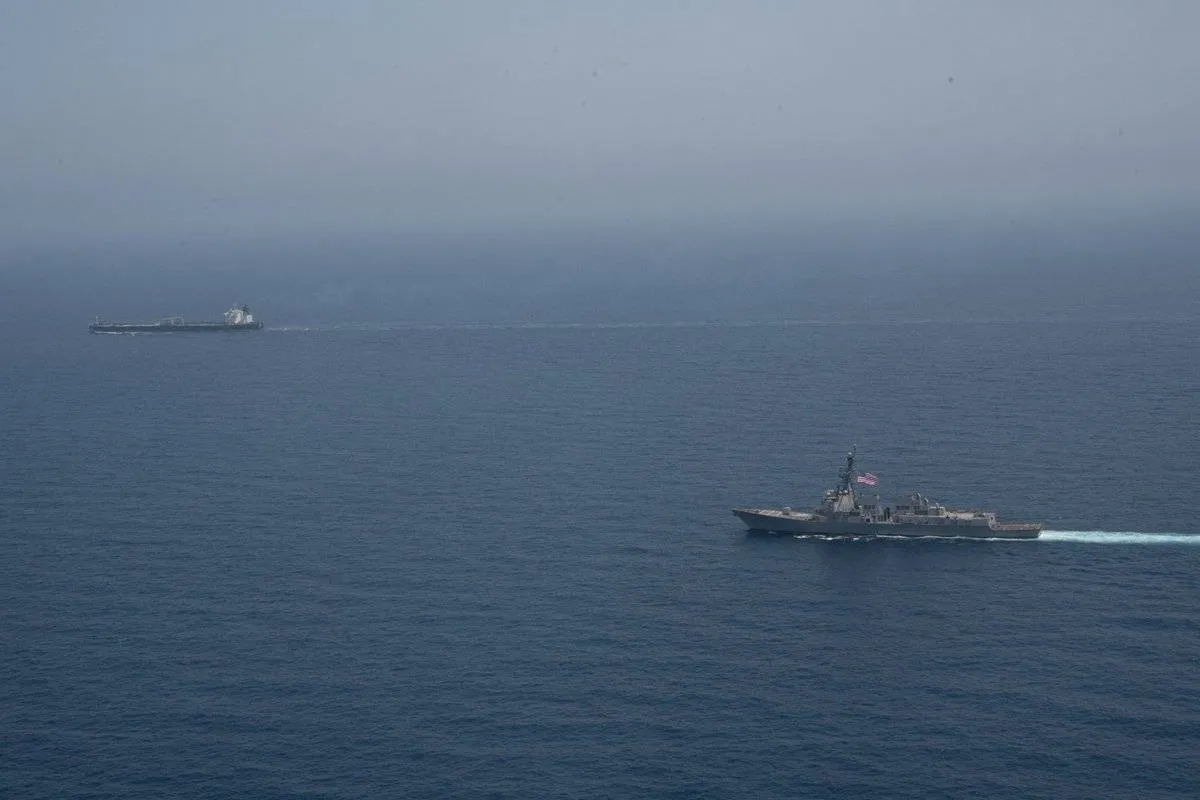
Data from ship tracking on Monday revealed that six Iranian oil tankers had to return to Iranian ports due to the blockade imposed by the United States, showcasing the increasing impact of the ongoing conflict between Tehran and Washington on maritime traffic through the Strait of Hormuz, one of the most crucial maritime routes for global oil exports.
Earlier on Monday, the US Central Command (CENTCOM) confirmed that its forces continued to enforce the blockade on Iranian ports, preventing ships from entering or exiting. Reports indicated that an American naval officer was monitoring one of the commercial vessels while US forces executed blockade operations, directing 38 ships to change their course or return to port.
Details of the Incident
Before the onset of the US-Israeli war on Iran on February 28, maritime traffic through the strait saw between 125 and 140 ships crossing daily. However, recent data shows that only seven vessels crossed the strait in the past day, none of which were carrying oil destined for the global market, according to the ship tracking company Kepler.
Among the crossing vessels was the dry cargo ship Bahvand, flying the Iranian flag, which departed from an Iranian port, along with other ships that left from Iraqi ports. Meanwhile, Iran imposed restrictions on navigation in the strait, while the United States announced on April 13 that it would enforce a blockade on maritime traffic related to Iran.
Background & Context
Tensions in the region have escalated since the beginning of the US-Israeli war on Iran, with maritime traffic through the Strait of Hormuz witnessing a significant decline. On April 25, the US military announced that it had redirected 37 ships since the blockade began. However, US forces did not provide precise details about the types of ships that were redirected or the locations where interceptions occurred.
In this context, analyses of satellite images showed that six Iranian tankers returned to the ports and then crossed the strait again in the past few days, carrying approximately 10.5 million barrels of oil. While US forces instructed some ships to return, others were allowed to continue sailing.
Impact & Consequences
Analysts assert that US forces are redirecting ships associated with Iran eastward to the Malacca Strait, raising questions about whether these shipments will reach buyers or face interception. Hundreds of ships and around 20,000 sailors remain stranded in the Arabian Gulf, complicating the situation further.
Under these circumstances, pressure is mounting on US President Donald Trump to make decisive decisions regarding the continuation of military operations. As the 60-day period stipulated by the War Powers Act approaches, Trump faces legal and political challenges regarding the legitimacy of continuing the military campaign against Iran.
Regional Significance
These developments directly affect the Arab region, where concerns are growing over the escalation of military tensions and their impact on oil prices and trade movement. The US blockade may exacerbate economic conditions in Iran, potentially reflecting on regional stability.
In conclusion, the situation in the Arabian Gulf remains tense, with the ongoing US blockade affecting maritime traffic and oil. The current situation requires close monitoring by Arab countries to ensure regional stability.