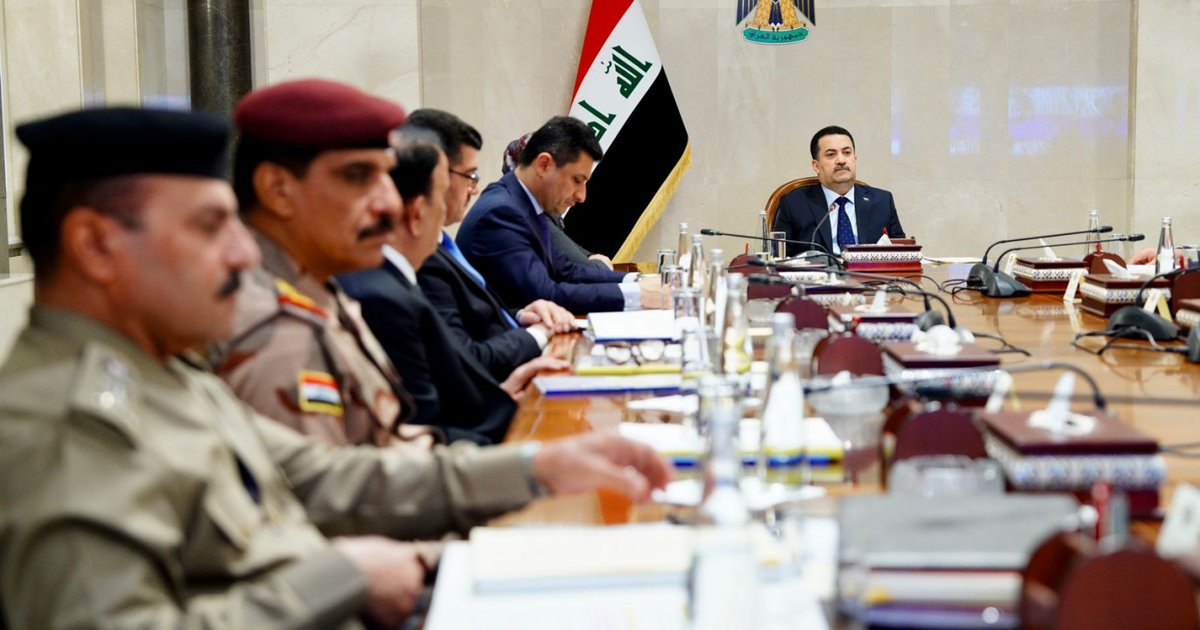
In a move reflecting the official direction towards enhancing security and stability, the Iraqi National Security Council confirmed today, Monday, the country's full right to defend itself and prevent any attempts to target it or use its territory as a platform to threaten neighboring countries.
This statement came during a meeting chaired by the Commander-in-Chief of the Armed Forces, Mohammed Shia' al-Sudani, where the council emphasized the necessity of restricting arms to the state and recommended taking strict measures against illegal entities. These recommendations come at a sensitive time as the government seeks to strengthen its control over internal security and dismantle armed groups operating outside the state's framework.
Details of the Meeting
During the meeting, the importance of taking necessary security, military, and legal measures to prevent any aggression against neighboring countries from Iraqi territory was underscored. The council also stressed the need to confront any targeting of diplomatic missions and facilities, considering any entity operating outside the state's framework a threat to national security that will face legal prosecution without exception.
The council pointed out that targeting neighboring countries from within Iraqi territory is considered a terrorist act, and emphasized that any harm to the security and safety of diplomatic missions is unacceptable and against the law. It recommended the dismissal and accountability of those involved in illegal activities and their referral to the judiciary.
Background & Context
These recommendations come amid rising regional tensions, as Iraq faces significant challenges related to security stability. Historically, the country has suffered from the impacts of armed groups that emerged after the American invasion in 2003, leading to the disintegration of state institutions and the emergence of multiple armed factions.
In recent years, the Iraqi government has attempted to strengthen its control over these factions, but challenges remain. Some groups seek to use Iraqi territory as a base for their operations, complicating the security situation further.
Impact & Consequences
This step by the National Security Council is seen as a serious attempt to enhance the sovereignty of the Iraqi state and regain control over arms. If these recommendations are effectively implemented, they could contribute to reducing internal tensions and enhancing regional security.
However, the biggest challenge remains how to deal with armed factions that may refuse to comply with these decisions. There is also an urgent need to enhance coordination with neighboring countries to ensure that their territories are not used as a launch pad for attacks against Iraq.
Regional Significance
These developments are of great importance to the Arab region, as the stability of Iraq directly affects regional security. Strengthening security in Iraq could help reduce tensions between neighboring countries and enhance regional cooperation.
In light of ongoing crises in the region, it is essential for Arab countries to adopt a unified approach to address security challenges, making dialogue and understanding the primary option for resolving crises.
In conclusion, the recommendations of the Iraqi National Security Council represent an important step towards enhancing security and stability, but the actual implementation of these recommendations will determine their success in achieving the desired goals.