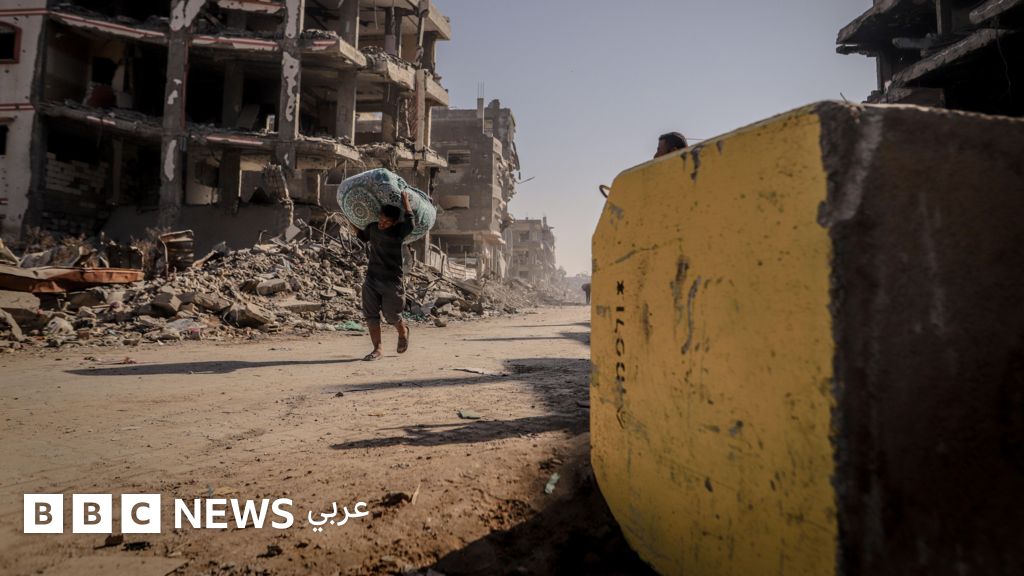
The Israeli newspaper Haaretz has confirmed that the Israeli army has turned what is known as the 'Yellow Line' within the Gaza Strip into a permanent military reality. The army has reinforced its presence in the area by establishing 32 military sites and constructing a land barrier extending approximately 17 kilometers.
The report clarifies that this line, which was previously considered a preliminary stage for a gradual withdrawal from the territory, has seen increased entrenchment and widespread military deployment along its length in recent months. The Yellow Line has become a central axis for Israeli military activity, with ongoing military operations in its vicinity, where more than 200 Palestinians have been martyred near this line in recent times.
Details of the Situation
The Yellow Line represents a separation zone within the Gaza Strip, where the Israeli army temporarily withdrew under a ceasefire agreement, with plans for further withdrawal stages to follow. In previous statements, Israeli Defense Minister Israel Katz affirmed that Israel would not withdraw from this line "by a single millimeter before disarming Hamas," reflecting the Israeli government's intention to maintain this military status quo.
These developments come at a time when the White House recently announced the structures for managing the transitional phase in Gaza, which include a "Peace Council," "Executive Council of Gaza," "National Committee for Gaza Management," and an "International Stabilization Force" tasked with securing the territory, disarming, ensuring humanitarian aid access, and reconstruction efforts.
Background & Context
This move falls under the second phase of former President Donald Trump's plan to end the war in Gaza, which consists of 20 points and is supported by UN Security Council Resolution 2803 issued on November 17, 2025. Gaza has witnessed an escalation in Israeli military actions, exacerbating the humanitarian situation in the territory.
On the ground, Israel continues its assaults within the Strip, where a Palestinian was martyred and others injured in an Israeli airstrike on central Gaza last Wednesday, according to the Civil Defense Authority in the area. Additionally, several wounded individuals were reported due to Israeli naval forces targeting tents of displaced persons in the Mawasi area west of Khan Younis.
Impact & Consequences
According to the Ministry of Health in Gaza, the number of casualties from the Israeli aggression since October 2023 has exceeded 72,000 martyrs and 171,000 injured Palestinians. The ceasefire agreement came into effect on October 10, 2025, following a genocidal war on the Strip that lasted two years and resulted in widespread destruction affecting nearly 90% of civilian infrastructure, with reconstruction costs estimated at around $70 billion.
Through this strategy, Israel aims to reinforce its military control over Gaza, complicating peace efforts and negatively impacting the humanitarian situation in the region.
Regional Significance
This development poses a significant challenge to security and stability in the region, raising concerns about escalating violence and tensions between Palestinians and Israelis. The continued Israeli military operations reflect the instability experienced in the Strip, affecting neighboring countries and complicating international mediation efforts.
In conclusion, the situation in Gaza remains complex, with military, political, and humanitarian dimensions intertwined, necessitating an urgent response from the international community to ensure the rights of Palestinians and achieve lasting peace in the region.