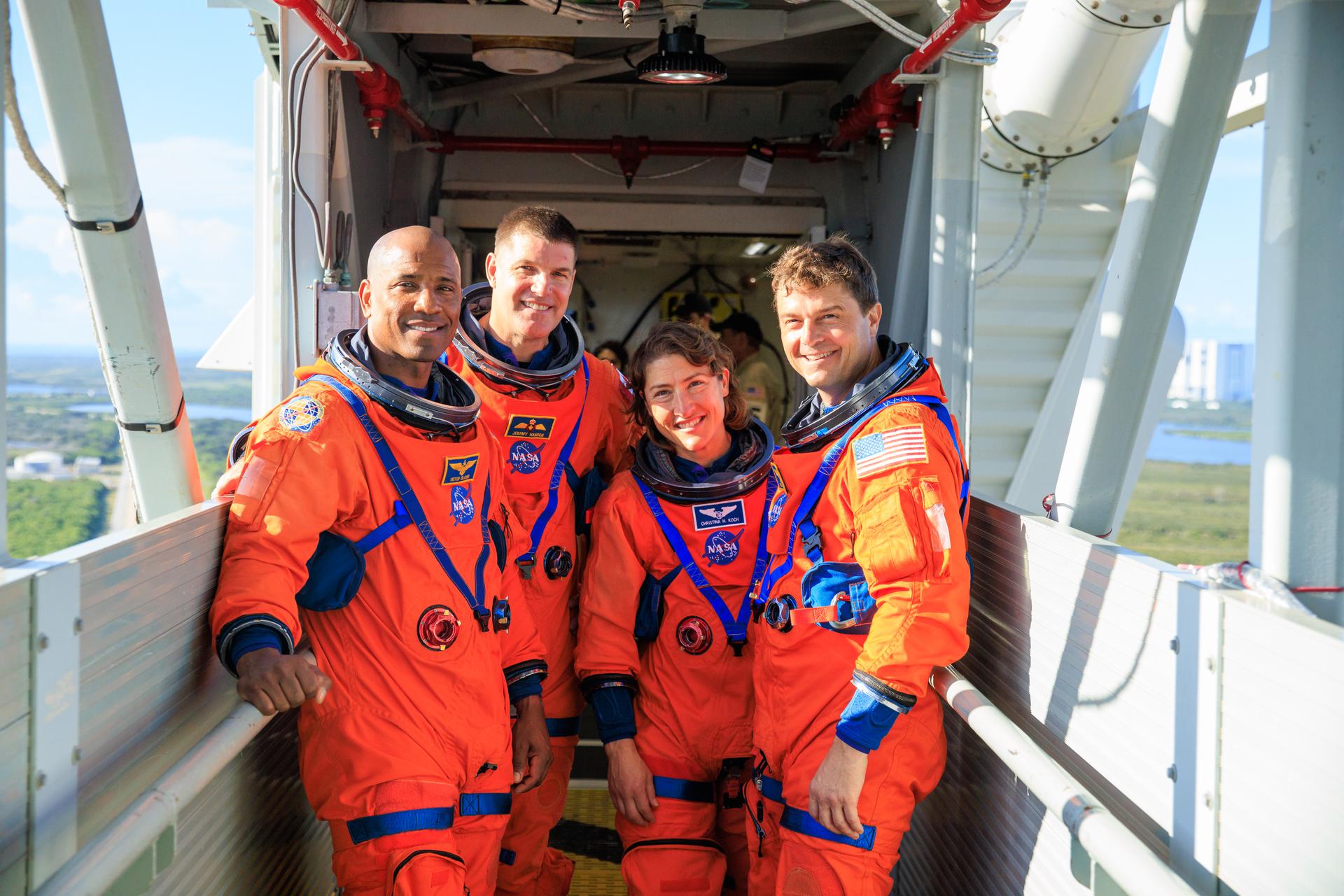
The Artemis-2 crewed mission to the Moon was launched at 1:35 AM on Thursday, April 2, 2026, Mecca time, in a historic journey carrying four astronauts. This mission represents humanity's return to the Moon after 54 years since the last crewed flight in the Apollo program.
From the Kennedy Space Center in Florida, the Space Launch System (SLS) rocket, the tallest in space history at 98 meters, lifted off carrying the Orion spacecraft. The spacecraft will complete one orbit around the Moon before returning to Earth on April 12, 2026.
Event Details
The mission will last for 10 days, during which the astronauts will travel approximately 1.1 million kilometers round trip around the Moon, equivalent to three times the distance between the Earth and the Moon. Although the goal is not to land on the Moon, the mission aims to test modern systems and technologies in a space environment.
The four astronauts will live in a space no larger than 9 square meters, where their ability to adapt to isolation and a limited environment will be tested. The mission timeline includes the launch, the journey to the Moon, the flyby, and the return to Earth, reflecting the meticulous planning and advanced technology used in this mission.
Background & Context
Artemis-2 is part of a larger program aimed at returning humans to the Moon, representing a critical step towards achieving broader goals that include landing on the lunar surface and establishing permanent lunar bases. Since the end of the Apollo program in 1972, no crewed missions to the Moon have taken place, making this mission a landmark in the history of space exploration.
Through this mission, NASA seeks to test the technologies necessary for future missions to Mars, making it part of a long-term plan for deep space exploration.
Impact & Consequences
The Artemis-2 mission is a vital test of humanity's ability to return to the Moon safely, enhancing the United States' position in the space race. The success of this mission could open doors for future missions aimed at landing on the Moon, boosting opportunities for scientific and commercial exploration.
This mission also represents an opportunity to develop new technologies that could be used in future space flights, contributing to advancements in science and technology on Earth.
Regional Significance
This mission presents an opportunity for Arab countries to enhance their investments in the space sector, potentially inspiring a new generation of scientists and engineers in the region. With increasing interest in space among Arab nations, Artemis-2 could open new avenues for international cooperation in space exploration.
The success of this mission may encourage Arab countries to develop their own space programs, enhancing their standing in the international scientific community.
The Artemis-2 mission represents a historic step towards space exploration, bringing humans back to the Moon after decades of absence. The success of this mission could open new horizons for space exploration and enhance international cooperation in this field.