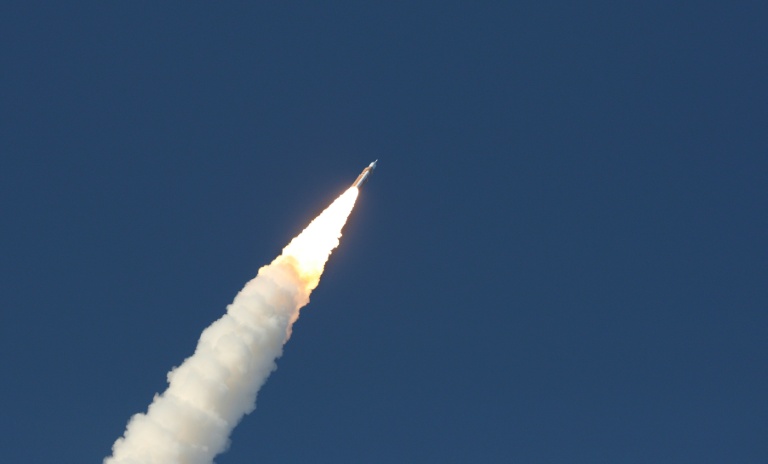
Four astronauts aboard a massive NASA rocket embarked on a long-awaited journey around the Moon, marking the first crewed mission to the Moon in over 50 years. The launch took place from Kennedy Space Center in Florida, where the event was met with great enthusiasm from teams and spectators. At exactly 6:35 PM local time, the giant rocket, carrying three Americans and one Canadian, soared into the sunny sky.
During the launch, one spectator expressed their excitement by saying, "We are going to the Moon!" Canadian astronaut Jeremy Hansen also shared his enthusiasm, stating, "We are going for humanity." In her remarks to the astronauts, Artemis Launch Director Charlie Blackwell-Thompson emphasized the importance of this mission, saying, "You carry with you the spirit of Team Artemis and the dreams of a new generation."
Event Details
The four astronauts, dressed in bright orange suits, are Reid Wiseman, Victor Glover, Christina Koch, and Jeremy Hansen. After the launch, they successfully entered Earth orbit, where they will conduct a series of checks to ensure the safety of the spacecraft, which has not carried astronauts before. They will also test manual flying capabilities during docking simulations.
If all goes as planned, they are expected to begin their journey around the Moon on Thursday, which is anticipated to take about three days. The entire mission will last approximately ten days, marking a significant step toward landing on the Moon in 2028.
Background & Context
This mission is part of the Artemis program, which aims to return humans to the Moon and establish a permanent base there. This program reflects the ambitions of the United States in space, as it seeks to be a leader in space exploration, especially amid increasing competition with China, which plans to land humans on the Moon by 2030.
The Artemis program has faced numerous challenges, including delays and cost overruns, as the launch was originally scheduled for earlier this year. However, the successful launch represents a milestone in the history of space exploration.
Impact & Consequences
This mission is a significant step toward achieving new goals in space exploration, as it will send the first woman and the first person of color to the Moon. If all goes as planned, this mission will set a record by traveling farther from Earth than any human has ever gone in history.
The United States aims to enhance its position in space through this mission, which could impact international policies regarding space exploration and cooperation among nations.
Regional Significance
Although this mission focuses on American space efforts, it has implications for the Arab region. Arab countries, such as the United Arab Emirates, are striving to enhance their space programs and have already launched a mission to Mars. These Arab achievements in space could inspire collaboration among Arab nations in the fields of science and technology.
In conclusion, the success of the Artemis mission represents an important step toward a bright future for space exploration and reflects global ambitions in this field. We are witnessing the beginning of a new era of exploration, where Arab countries can play a significant role in this domain.