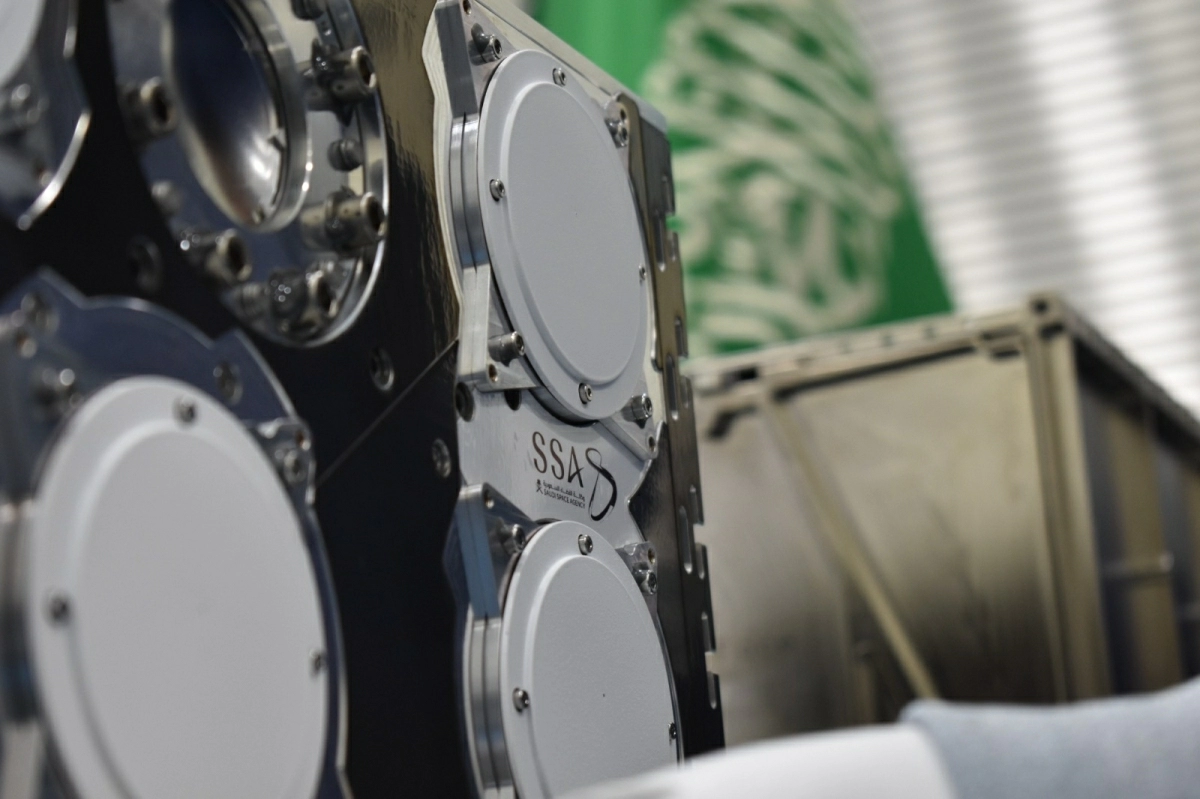
The Saudi Space Authority has announced the successful launch of the satellite 'Shams', which was launched aboard the Space Launch System (SLS) as part of the Artemis II mission. This achievement represents a historic turning point, as the Kingdom of Saudi Arabia becomes the first Arab country to participate in NASA's Artemis program, which aims to enhance scientific innovation and strengthen international partnerships in the field of space exploration.
The Artemis II mission is the second phase of the Artemis program, led by NASA with extensive international collaboration, aiming to return humans to lunar orbit for the first time in over five decades, paving the way for future missions to Mars. The mission carries a crew of four astronauts aboard the Orion spacecraft, marking the first crewed mission to orbit the Moon, supported by the most powerful launch system ever.
Event Details
The 'Shams' satellite will operate in a High Elliptical Orbit (HEO), ranging from approximately 500 km to 70,000 km from Earth, allowing it to provide extensive coverage for monitoring solar and radiative activity and supporting advanced studies on space weather. This satellite represents several achievements, including being the first Arab mission launched under the Artemis program and the first Saudi mission dedicated to studying space weather.
The satellite was developed locally by Saudi talents, supported by initiatives under the National Industrial Development and Logistics Program (NIDLP), which is one of the main programs of Vision 2030. The mission aims to study space weather through four scientific fields: space radiation, solar X-rays, the Earth's magnetic field, and high-energy solar particles.
Background & Context
This step comes as part of Vision 2030, launched by Saudi Crown Prince Mohammed bin Salman, aiming to diversify the Saudi economy and enhance innovation across various fields, including space. The Kingdom has recently witnessed significant progress in technology and innovation, reflecting its commitment to developing national capabilities in this field.
Saudi Arabia's participation in the Artemis program is a strategic move that reflects its desire to be part of global efforts in space exploration, seeking to build partnerships with advanced countries in this field, thereby enhancing its international standing.
Impact & Consequences
The launch of the 'Shams' satellite is a significant achievement not only for Saudi Arabia but for the entire Arab world. This accomplishment reflects the ability of Arab nations to actively participate in advanced science and technology fields. Additionally, the data collected from the satellite will support vital sectors such as communications, aviation, and navigation, enhancing operational readiness and strengthening the resilience of critical infrastructure.
Dr. Mohammed Al-Tamimi, CEO of the Saudi Space Authority, stated that this achievement reflects the Kingdom's rapid progress in advanced technologies, supported by the wise leadership of King Salman and the Crown Prince. Engineer Jamil Al-Ghamdi, CEO of the NIDLP program, also noted that the local development of 'Shams' highlights the program's role in localizing advanced technologies and building competitive national capabilities.
Regional Significance
This achievement represents a new starting point for Arab countries in the field of space, potentially inspiring other nations to develop their own space programs. Cooperation among Arab countries in this field can contribute to enhancing innovation and knowledge exchange, benefiting all Arab nations.
In conclusion, the launch of the 'Shams' satellite is a historic step that reflects Saudi Arabia's commitment to innovation and international cooperation in space exploration, opening new horizons for a bright future in this field.