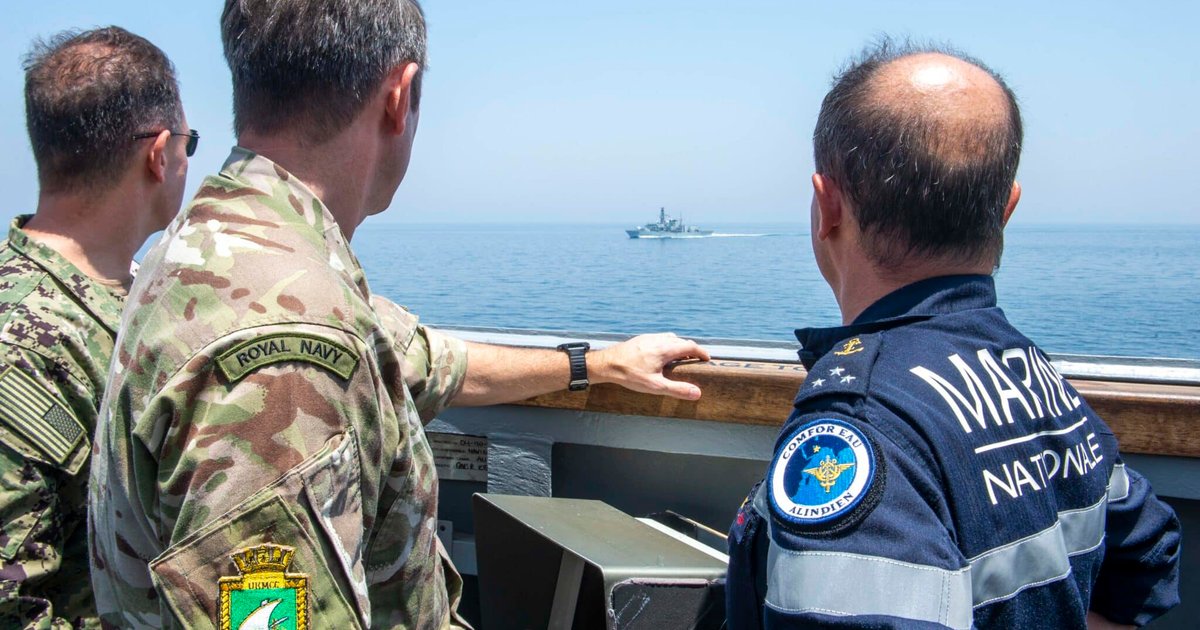
French President Emmanuel Macron revealed today, Friday, his country's plan to reopen the Strait of Hormuz in collaboration with other nations, through a peaceful operation aimed at escorting oil tankers and commercial ships. Macron emphasized that "it is impossible to solve the problems caused by Iran through bombing," indicating that military solutions will not yield positive results.
In previous statements, Macron considered any military operation to reopen the strait to be "unrealistic," as it would require a long time and expose anyone crossing the strait to threats. These remarks come at a sensitive time, as the United Nations Security Council postponed voting on a draft resolution submitted by Bahrain allowing the use of "defensive force" to protect navigation in the strait.
Details of the Event
The New York Times reported that a diplomat and a UN official stated that Russia, China, and France thwarted the efforts of Arab countries to request a mandate from the Security Council for military action against Iran. In a related development, a container ship owned by the French group CMA CGM crossed the Strait of Hormuz, marking the first European vessel to do so since it was closed following the outbreak of the US-Israeli conflict against Iran 35 days ago.
The vessel, named Krebi, flying the flag of Malta, crossed the strait from west to east and continued its journey off the coast of Oman without specifying its destination. The ship passed north of Larakeh Island near the Iranian coasts, on a maritime route believed to have been agreed upon with the Iranian Revolutionary Guard.
Background & Context
Earlier, the maritime navigation company Lloyd's reported that ships wishing to adopt this safe route must pay a fee to Tehran. China confirmed that three container ships crossed the Strait of Hormuz, while Malaysia reported that Iran allowed its oil tankers to pass without paying fees.
It is noteworthy that Iran has repeatedly stated that it will not allow the passage of ships linked to countries participating in attacks against it, emphasizing that it may allow ships from friendly countries to pass based on prior coordination.
Impact & Consequences
The closure of the Strait of Hormuz, through which about 20% of global oil and liquefied gas supplies pass, has led to a sharp rise in energy prices and disruption of supply chains. Maritime traffic through the strait has decreased unprecedentedly, with the number of crossing vessels dropping by 93% compared to pre-war periods, according to data from Kepler maritime analytics.
Data shows that about 225 raw material tankers have crossed the Strait of Hormuz since the outbreak of the war, reflecting the significant impact of the conflict on global trade movement.
Regional Significance
These developments are of great importance to the Arab region, as reopening the Strait of Hormuz will contribute to stabilizing oil prices and enhancing trade movement. Additionally, cooperation between European and Arab countries in this context may help alleviate regional tensions.
In conclusion, all eyes remain on how the situation in the Strait of Hormuz will evolve, and whether peaceful efforts will yield positive results that ensure the safe passage of ships.