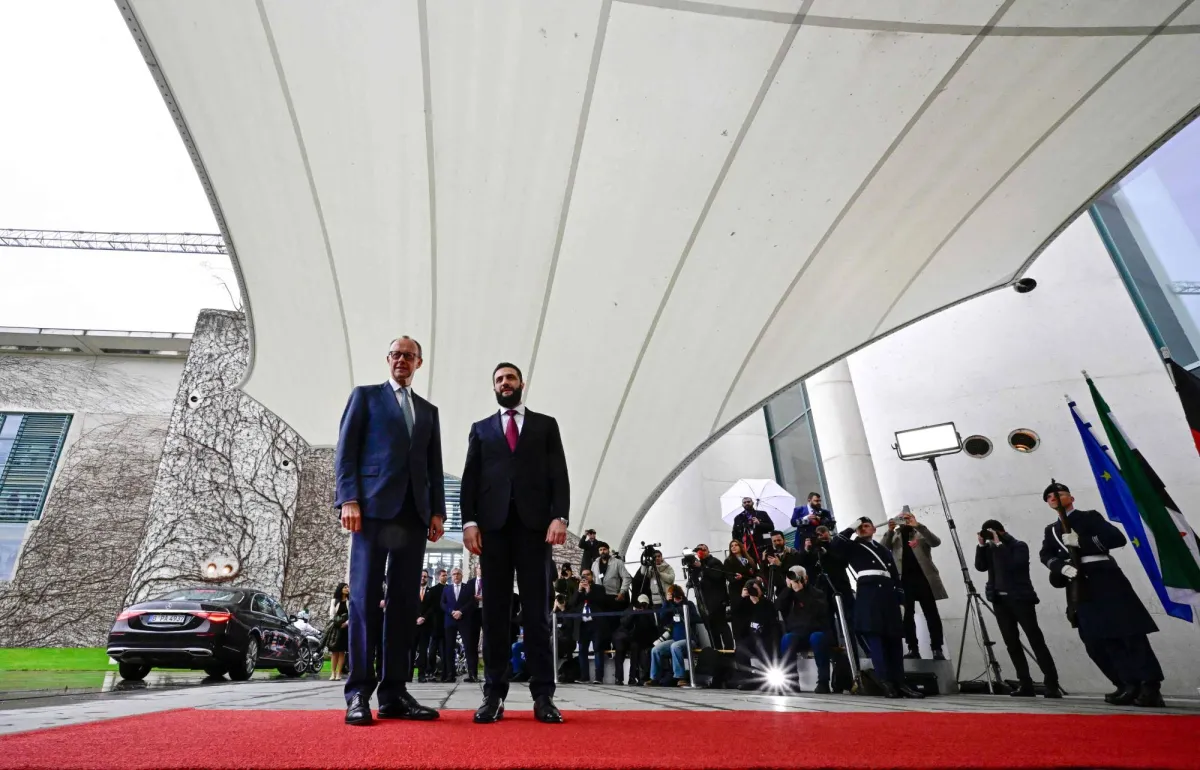
German Chancellor Friedrich Merz announced today, during a joint press conference with Syrian President Ahmad al-Shara, a plan aimed at repatriating approximately 80% of the Syrians residing in Germany. This announcement comes at a time when the number of Syrian refugees in Germany exceeds 900,000, reflecting new shifts in Germany's immigration policy towards the Syrian crisis.
During the conference held in Berlin, Merz emphasized that the majority of Syrians who sought refuge in Germany during the regime of ousted President Bashar al-Assad wish to return to their homeland to contribute to its reconstruction. He noted that this return should occur in a safe and free environment, expressing his welcome for the participation of the Syrian government in this effort.
Details of the Event
President Ahmad al-Shara arrived in Berlin leading a government delegation that included Foreign Minister Asaad al-Shibani, Minister of Economy Nidal al-Shaar, and Minister of Energy Mohammad al-Bashir. He was received at the Belvue Palace by the President of the Federal Republic of Germany, Frank-Walter Steinmeier. During the conference, Merz stated, "In the long term, about 80% of the Syrians currently residing in Germany are expected to return to their homeland."
For his part, President al-Shara confirmed that the Syrian government is working with German partners to establish a circular migration program, which allows Syrian talents to contribute to the reconstruction of their homeland without abandoning their lives in Germany. He pointed out that Syria represents an ideal opportunity for a Syrian-European partnership led by Germany.
Background & Context
This step is part of broader efforts to rebuild relations between Syria and Germany, as both parties seek to enhance economic and political cooperation. Al-Shara noted that there are 1.3 million Syrians in Germany, including 6,000 doctors, reflecting their significant role in the German economy.
Merz also announced Germany's intention to support the reconstruction of Syria post-war, indicating that a delegation from the German government will visit Damascus in the coming days. However, he pointed out that these projects will depend on developments in strengthening the foundations of the rule of law in Syria.
Impact & Consequences
This initiative comes at a sensitive time, as Syria suffers from the effects of a war that has lasted for over a decade. The repatriation of refugees could contribute to restoring stability in the country, but it also requires adequate security and economic guarantees. Additionally, this step may impact relations between European countries and Syria, especially amid current political tensions.
It is important that this issue is handled with caution, as the return of refugees must occur under safe conditions, providing them with the necessary support to reintegrate into Syrian society after years of displacement.
Regional Significance
These developments are particularly significant for the Arab region, as they contribute to reshaping relations between Arab countries and Europe. Strengthening cooperation between Syria and Germany could open the door for more investments and economic aid, contributing to regional stability.
In conclusion, this initiative remains a true test of the political will of all parties involved and their ability to achieve peace and stability in Syria and the region.