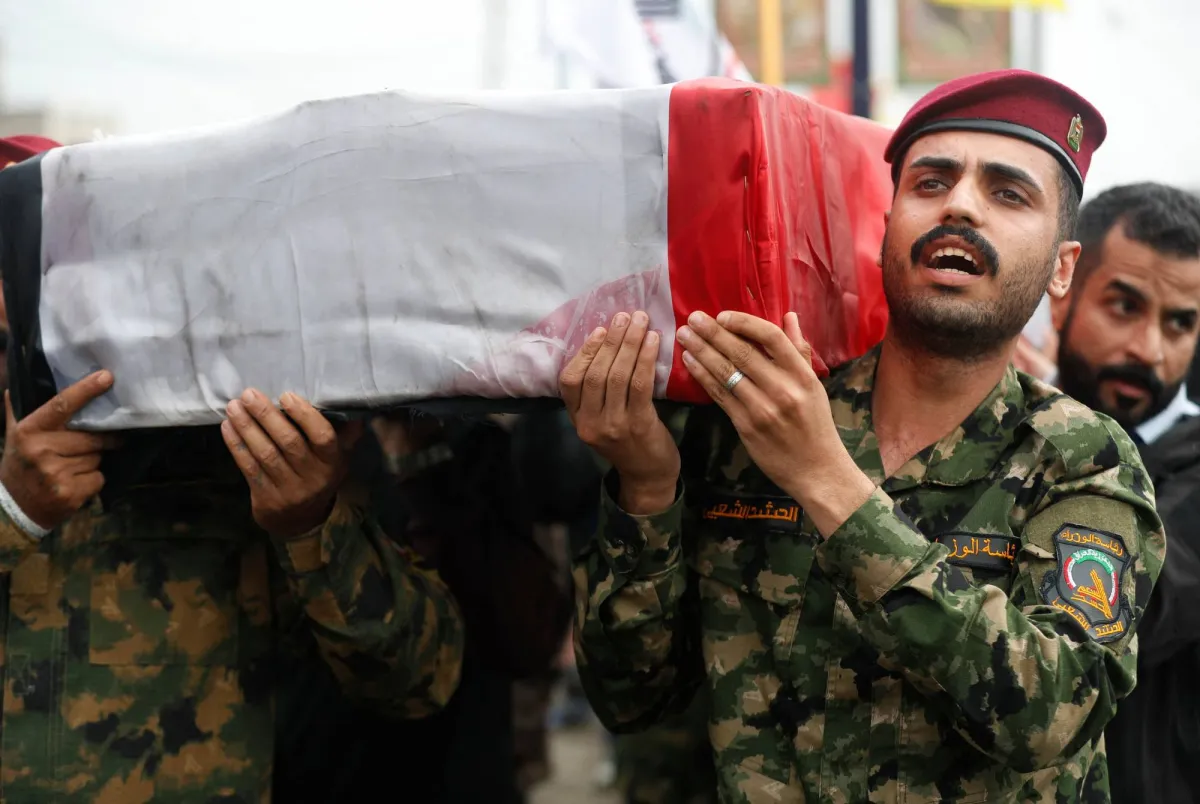
Iraq is witnessing unprecedented military escalation as the United States launches attacks on Popular Mobilization Forces, while Iran bombards Kurdish Peshmerga troops. This comes amid Iraqi government assurances of avoiding entanglement in regional conflicts.
Despite official statements affirming the Iraqi government's desire to distance the country from the spiral of regional war, recent events indicate that Iraq is entering an actual military conflict. The United States continues its attacks on Popular Mobilization sites, while Iran executes strikes against Kurdish Peshmerga forces in northern Iraq.
Details of the Incident
On Tuesday morning, Iraq experienced the strongest wave of military escalation since the beginning of the regional conflict last February. Reports indicated that an airstrike, believed to be American, resulted in the death of the commander of the Anbar Operations in the Popular Mobilization, Saad Duwai, along with several soldiers. The Popular Mobilization Authority confirmed in a statement that the attack targeted their command headquarters while they were performing their national duty.
The Security Media Cell of the Joint Operations Command announced that 15 members of the Popular Mobilization were killed in the attack, considering these assaults aimed at undermining security and stability in Iraq. In a related context, the Commander-in-Chief of the Armed Forces, Mohammed Shia' al-Sudani, called for an emergency meeting of the National Security Ministerial Council to discuss the repercussions of these attacks.
In another development, sites belonging to leaders in the Popular Mobilization were subjected to airstrikes north of Mosul, resulting in smoke rising from the targeted site. Unconfirmed reports circulated about the death of the head of the Popular Mobilization Authority, Faleh al-Fayyad, in this attack, which has not been officially confirmed or denied.
Background & Context
These developments come at a sensitive time, as the region witnesses rising tensions between regional powers. Following the US-Israeli attack on Iran, the conflict in Iraq has intensified, where armed factions loyal to Tehran are present. These factions have confirmed their readiness to respond to any attacks targeting them, complicating the security situation in the country.
Conversely, Kurdish Peshmerga forces in northern Iraq have been subjected to Iranian ballistic missile attacks, resulting in the death and injury of 36 personnel. The Ministry of Peshmerga Affairs condemned this attack, considering it an assault on Iraq's sovereignty. The President of the Kurdistan Region, Nechirvan Barzani, called on the Iraqi government and the international community to take action to protect Iraq's sovereignty.
Impact & Consequences
Concerns are growing over the escalation of violence in Iraq, as this escalation could destabilize the entire region. Many observers indicate that the continuation of these attacks may exacerbate security conditions and increase the suffering of civilians living in conflict areas.
Moreover, these events could impact relations between Iraq and its neighbors, especially with Iran, which considers the Popular Mobilization part of its regional strategy. These tensions may lead to an escalation of conflict among armed factions in Iraq, complicating the political and security landscape in the country.
Regional Significance
The events in Iraq are part of a broader conflict encompassing the entire region, where regional and international interests intersect. The tensions between the United States and Iran, along with internal conflicts in Iraq, could lead to serious repercussions for regional security.
Furthermore, the continuation of attacks on the Popular Mobilization and Peshmerga could worsen the humanitarian situation in Iraq, where civilians suffer from the effects of ongoing conflict. The international community must intervene to protect civilians and ensure that security conditions do not deteriorate further in the region.
In conclusion, the situation in Iraq remains complex, as internal and external factors intertwine to shape the security landscape. The Iraqi government must take serious steps to protect the country's sovereignty and ensure its stability amid these increasing challenges.