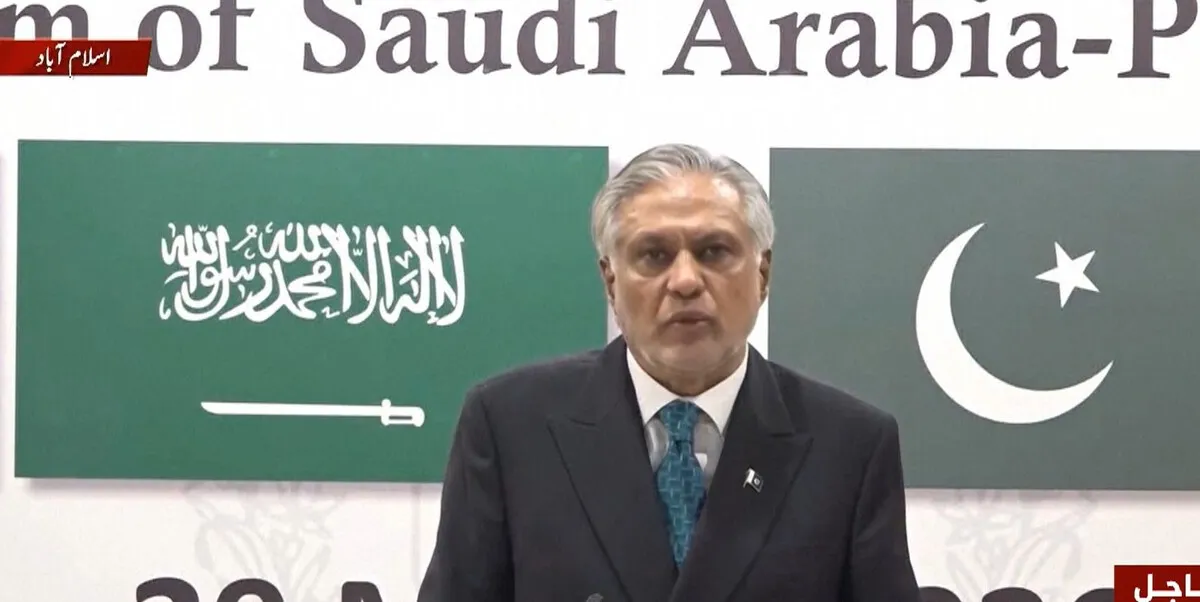
Pakistani Foreign Minister Muhammad Ishaq Dar stated on Sunday that the second meeting of foreign ministers from Pakistan, Saudi Arabia, Turkey, and Egypt in Islamabad focused on exploring ways to quickly and permanently end the war in the Middle East. Dar explained in a press conference following the meeting that the ongoing conflict in the region only leads to death and destruction, which is not in the interest of any party.
Dar added that the meeting addressed de-escalation in the U.S.-Iranian conflict, noting that all parties expressed confidence in Pakistan's mediation efforts. He affirmed that Pakistan plays a pivotal role in facilitating dialogue between Tehran and Washington, which requires strong international support.
Details of the Meeting
The meeting, held in the Pakistani capital, lasted several hours and included separate discussions between Dar and his counterparts, as well as a meeting with Pakistani Army Chief Asim Munir. The discussions centered on how to contain the escalating tensions in the region, especially following the U.S.-Israeli attack on Iran on February 28.
Dar clarified that China expressed its full support for the initiative to host Iranian-U.S. talks in Islamabad, and the United Nations Secretary-General also voiced support for this initiative. Many foreign ministers around the world have shown confidence in Pakistan's ability to facilitate dialogue and achieve positive outcomes.
Background & Context
This initiative comes at a sensitive time for the Middle East, where tensions between Iran and the United States are escalating, threatening regional stability. In recent years, there has been an increase in armed conflicts, exacerbating humanitarian and economic crises in many countries.
Historically, Pakistan has sought to play a mediating role in regional disputes, leveraging its good relations with both Iran and Saudi Arabia. This meeting reflects a regional trend towards enhancing diplomatic cooperation and seeking peaceful solutions to conflicts.
Impact & Consequences
If Pakistan succeeds in making progress in the talks between Iran and the United States, it could lead to a reduction in tensions in the region, contributing to greater stability. Conversely, failure of this initiative could escalate the conflict, negatively impacting regional and international security.
These efforts are part of a broader strategy aimed at promoting peace and security in the Middle East, as the international community seeks to find lasting solutions to ongoing disputes. International support will be crucial for the success of this initiative, requiring comprehensive cooperation from all involved parties.
Regional Significance
These developments are significant for the Arab region, as any improvement in relations between Iran and the United States could positively affect neighboring Arab countries. Additionally, de-escalation in conflicts may open up new opportunities for regional cooperation in various fields, including economics and security.
In conclusion, there is hope that these efforts will yield positive results, contributing to peace and stability in the Middle East and restoring hope for its peoples for a better future.