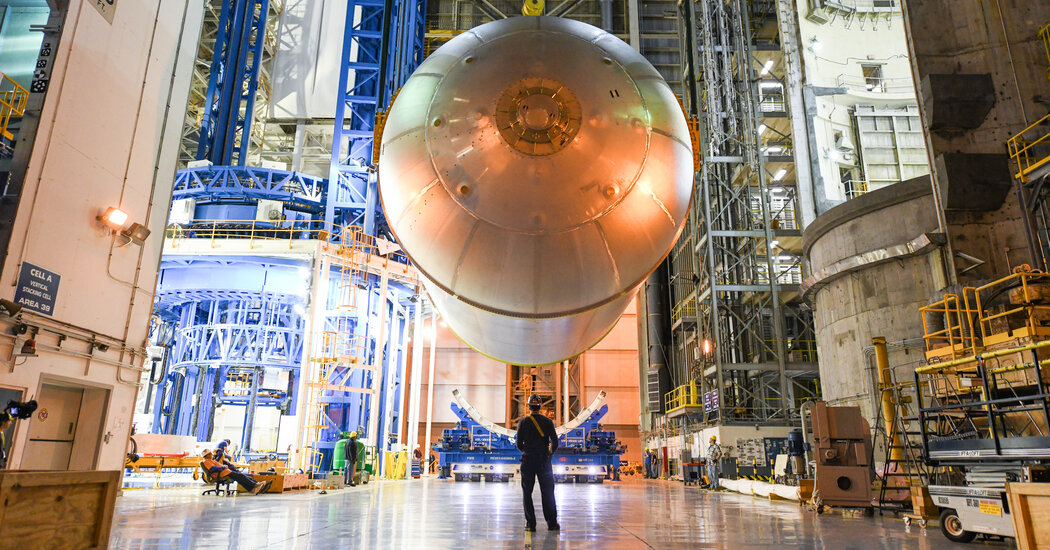
NASA has announced that the four astronauts involved in the Artemis mission have successfully completed their journey around the Moon, making a historic pass behind it. This mission not only set a record for distance traveled but also brought humans closer to the lunar surface than ever before in over 50 years.
The four astronauts, representing a part of the Artemis program, embarked on this mission with the goal of exploring the Moon and returning humans to its surface. The journey, which began several days ago, saw them flying in orbit around the Moon, providing them with a unique opportunity to view the Moon from angles they had never seen before.
Details of the Event
During this journey, the astronauts were able to conduct multiple scientific experiments, in addition to capturing stunning images of the lunar surface. They were equipped with advanced devices to monitor their surrounding environment, contributing to a better understanding of the conditions in outer space. This mission is part of a larger plan aimed at returning to the Moon and exploring other planets in the future.
This mission is part of the Artemis program, which aims to return humans to the Moon by 2024, with NASA seeking to establish a permanent base on the lunar surface. This base will aid in preparations for future missions to Mars and other planets.
Background & Context
The history of space exploration dates back over half a century, with the first human journey to the Moon occurring in 1969 during the Apollo 11 mission. Since then, humanity has witnessed significant advancements in space technology, allowing for a deeper understanding of the universe. The Artemis program represents a strong return for the United States to the Moon after decades of decline in space exploration.
Through this program, NASA aims to enhance international cooperation in space, with many countries participating in these efforts. There is also a growing interest from the private sector in space exploration, opening new avenues for collaboration and innovation.
Impact & Consequences
Achieving this milestone is considered an important step towards realizing larger goals in space exploration. Success in this mission may encourage further investments in the space sector, both from governments and private companies. Additionally, this success reinforces the United States' position as a leading power in space.
Moreover, this achievement could inspire a new generation of scientists and engineers, contributing to the development of new technologies that may have applications on Earth. Space exploration is not just an adventure; it is an investment in the future of humanity.
Regional Significance
Looking at the Arab region, this achievement could have positive implications for cooperation in space. Many Arab countries have begun developing their own space programs, such as the United Arab Emirates, which launched the Hope Probe to Mars. These accomplishments reflect a growing interest in space exploration and technology development.
Furthermore, collaboration between Arab countries and global space agencies could enhance scientific and technological capabilities in the region, benefiting Arab communities.