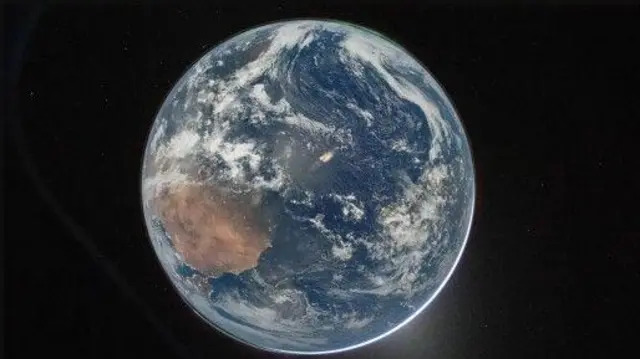
NASA has announced an exciting advancement in the Artemis-2 mission, as the spacecraft has successfully reached the halfway point between Earth and the Moon. This mission is part of the agency's efforts to return humans to the Moon and is considered a crucial step towards deeper space exploration.
As part of this progress, NASA compared two images of Earth, with the recent image captured during the Artemis-2 mission, while the other dates back to 1972 during the Apollo-17 mission. This comparison highlights the changes that Earth has undergone over the decades and underscores the importance of space exploration in understanding our planet.
Event Details
The Artemis-2 mission, which launched earlier this year, aims to send astronauts to the Moon and is part of the Artemis program that seeks to return to the Moon by 2024. The spacecraft, carrying four astronauts, is on schedule, and the images captured from space showcase stunning views of Earth.
The recent image presents Earth from a new perspective, having been taken from a high altitude, allowing for a comprehensive view of the planet. In contrast, the older image from Apollo-17 depicts Earth differently, reflecting the environmental and technological changes that have occurred over the years.
Background & Context
The Apollo-17 mission, launched in 1972, was the last crewed mission to the Moon under the Apollo program. During that mission, astronauts collected samples from the lunar surface, conducted scientific experiments, and provided humanity with the first close-up images of the Moon. Since then, humanity has witnessed tremendous advancements in space technology, making a return to the Moon possible.
The Artemis program represents a new step in space exploration, aiming to lay the groundwork for exploring Mars and deeper space. Through this program, NASA seeks to enhance international cooperation in space and expand the horizons of scientific research.
Impact & Consequences
The Artemis-2 mission is a milestone in the history of space exploration, reflecting humanity's commitment to the pursuit of knowledge and understanding the universe. The success of this mission could open doors for further explorations and enhance the ability of nations to collaborate in the fields of space and technology.
Progress in this mission may also impact scientific research related to climate change, as data collected from space can provide new insights into environmental changes on Earth. Additionally, the images captured may inspire future generations of scientists and engineers.
Regional Significance
The Artemis-2 mission presents an opportunity for Arab countries to enhance their interest in space and technology fields. With increasing investments in this sector, Arab nations can play a growing role in space exploration. Collaboration with global space agencies like NASA can strengthen the capabilities of Arab countries in this domain.
Moreover, the success of this mission may encourage Arab youth to engage in science and technology fields, contributing to the development of their skills and increasing job opportunities in the future.
In conclusion, the progress of the Artemis-2 mission represents a significant achievement in the field of space exploration and reflects humanity's commitment to the pursuit of knowledge. As this mission continues, we can expect more discoveries that may change our understanding of the world around us.