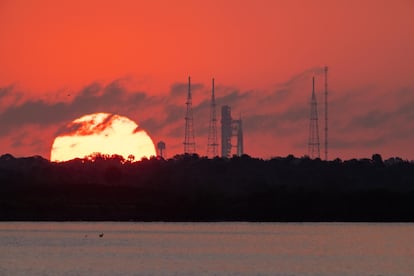
NASA is preparing to launch Artemis 2, a mission that will see four astronauts travel to the moon, in a move aimed at reaffirming American control over the lunar surface in the face of global challenges. The mission is scheduled for launch in four days, during which the most powerful rocket engines in space history will be ignited to carry the astronauts on a historic journey to the moon.
The mission crew includes Christina Koch, who will be the first woman to travel to the moon, and Victor Glover, who will be the first astronaut of African descent to participate in this journey. The crew also features commander Reid Wiseman and Canadian expert Jeremy Hansen, marking the first non-American to join this mission.
Mission Details
The journey will last for 10 days, during which the astronauts will orbit the moon, including an exploration of the moon's dark side, a region unseen by humans before. The mission is considered a vital test for the Artemis program, which aims to establish a permanent base on the moon by 2032.
This mission comes as part of a new American vision for space exploration, with Jared Isaacman, NASA's director, emphasizing that the United States will make every effort to ensure no other country, such as China, seizes control of the moon. These statements reflect American ambitions in space, as officials believe that dominance in space mirrors the global power of the United States.
Background & Context
Historically, the United States sent the first human to the moon in 1969 during the Apollo 11 mission. Since then, no crewed missions have returned to the moon, making Artemis 2 a significant milestone in space history. Concurrently, competition with China is increasing, as they plan to send a crewed mission to the moon by 2030.
NASA's plan also includes establishing a base on the moon, which could house nuclear reactors for power generation, reflecting a shift in how space exploration is conducted. These plans come at a time of geopolitical tensions worldwide, increasing the importance of space dominance.
Impact & Consequences
This mission is a strategic step for the United States, aiming to enhance its presence in space and ensure no other country surpasses it. Given the current tensions with Iran and China, this mission could influence international relations and reshape alliances in space.
Moreover, the success of this mission could pave the way for increased investments in space programs, fostering innovation and technology in this field. There is also growing interest from the private sector, as entrepreneurs like Elon Musk and Jeff Bezos compete to develop new technologies for space exploration.
Regional Significance
For the Arab region, these developments in space could mean new opportunities for scientific and technological collaboration. Arab countries could benefit from these innovations in areas such as communications and scientific research, enhancing their standing on the international stage.
Additionally, the increasing focus on space could inspire Arab youth to engage in science and technology fields, contributing to the development of their skills and capabilities for the future.