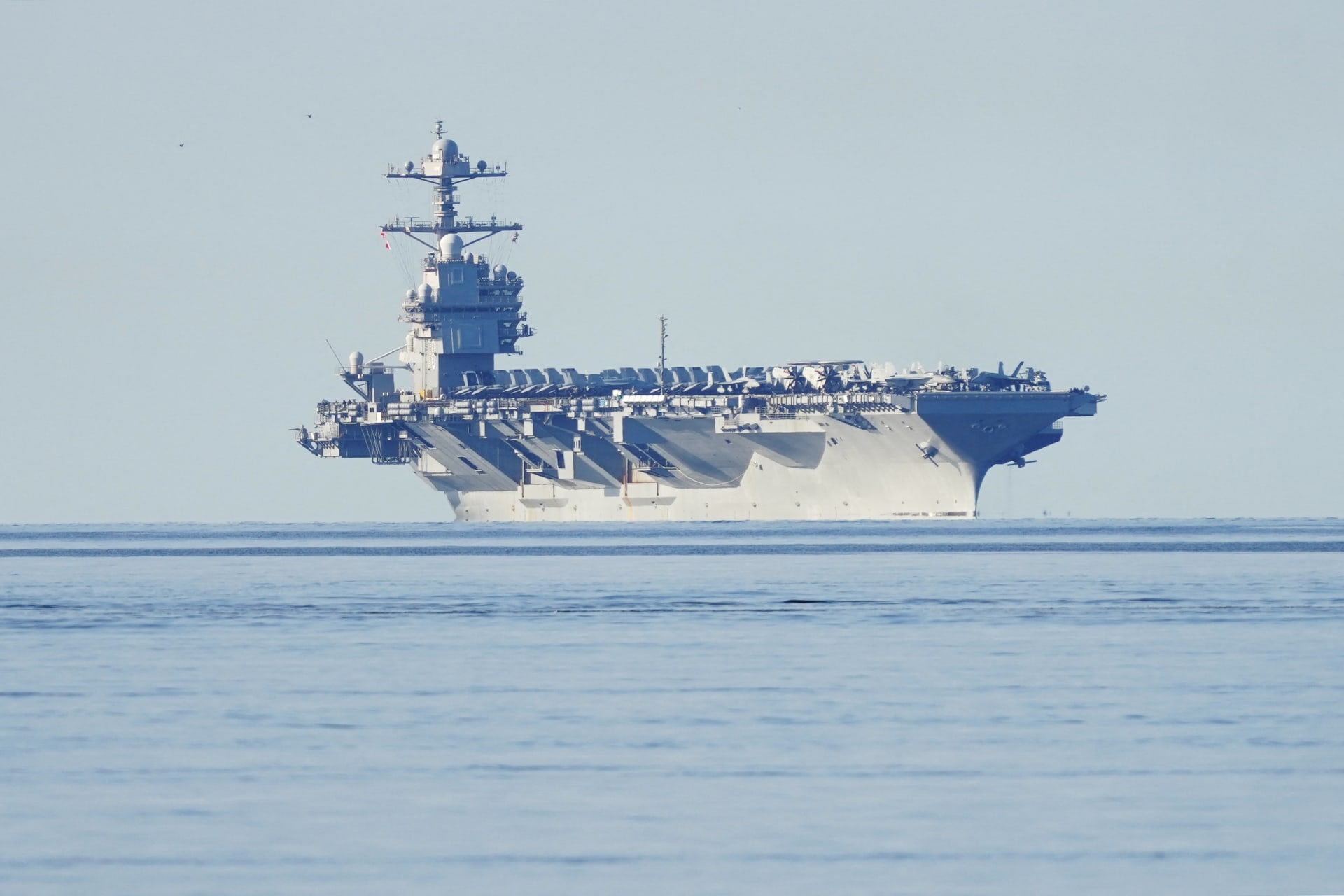
A report from the United States Department of Defense (Pentagon) indicates that the aircraft carrier USS Gerald R. Ford is facing deep technical problems, raising concerns about its ability to continue military operations, particularly if it comes under enemy fire. The report suggests that these issues far exceed the impact of the fire that broke out in the laundry room.
These warnings came after the carrier Ford arrived at the Souda Bay naval base on the Greek island of Crete, having departed from the Middle East due to the fire that affected its operational plans against Iran. The incident has raised questions about the readiness of this ship, which is considered one of the newest and most expensive American warships, delivered in May 2017 at a cost of $13.2 billion.
Details of the Incident
The Pentagon report reveals increasing concern regarding the systems of the Ford aircraft carrier, particularly the aircraft launch system and radar systems. Officials confirmed that the carrier's continuation in military operations is not guaranteed in the event of an attack. This situation highlights the challenges faced by the U.S. Navy amid escalating tensions in the Middle East.
After the departure of the Ford, only one aircraft carrier remains, the USS Abraham Lincoln, to support U.S. military operations in the region, increasing pressure on naval forces amid rising threats.
Background & Context
The USS Gerald R. Ford is part of a new generation of American aircraft carriers designed to be more efficient and capable of performing a variety of military missions. However, its delivery has been delayed due to multiple technical issues, sparking widespread criticism from observers and military experts.
This carrier is seen as a symbol of American military superiority, but repeated incidents and technical problems may affect its reputation and ability to operate in complex combat environments. In recent years, the region has witnessed rising tensions between the United States and Iran, making it essential for naval forces to be fully prepared.
Impact & Consequences
The issues facing the Ford aircraft carrier serve as a wake-up call for U.S. military leadership, reflecting the challenges that naval forces face in maintaining readiness under changing conditions. If these problems persist, they could impact U.S. strategy in the region, especially if tensions with Iran escalate.
Moreover, these circumstances could lead to a reassessment of U.S. military plans, potentially affecting the balance of power in the region. In the event of any military escalation, the inability of the Ford to participate could weaken the United States' position against threats.
Regional Significance
Arab countries are directly affected by the tensions between the United States and Iran, as any military escalation could lead to economic and security repercussions for the region. With only one aircraft carrier available to support military operations, Arab nations may feel concerned about the United States' ability to protect its interests in the area.
Additionally, the issues with the Ford aircraft carrier could lead to increased tensions among regional powers, prompting Arab countries to take proactive steps to ensure their security and stability under these changing circumstances.
In conclusion, the USS Gerald R. Ford remains under scrutiny, as the current and future challenges will require the United States to reassess its military strategies in the region.