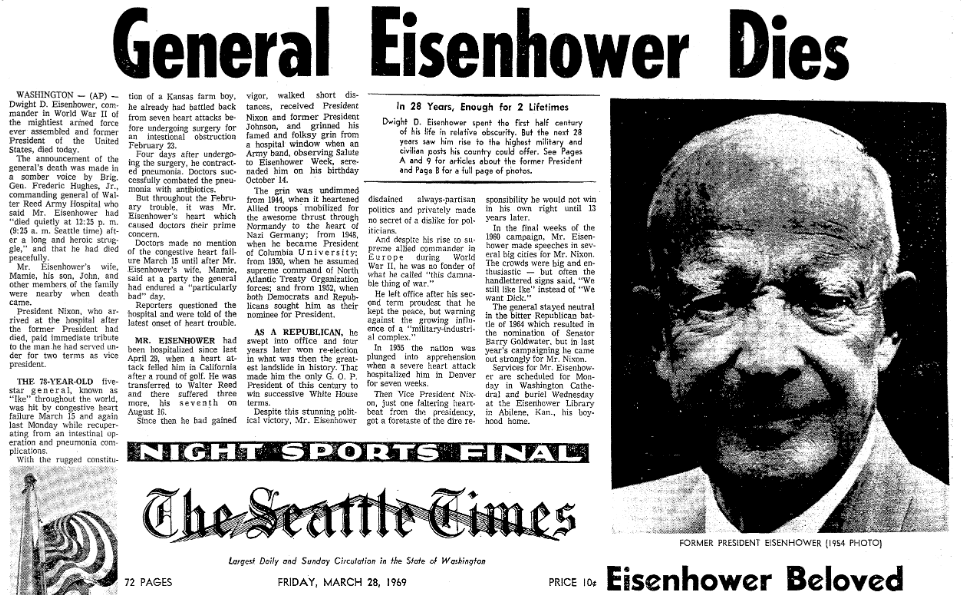
On March 28, 1969, former U.S. President Dwight Eisenhower passed away at the age of 78. Eisenhower is considered one of the most prominent military and political leaders in U.S. history, having served as president from 1953 to 1961. During his presidency, he faced numerous domestic and foreign challenges and played a significant role in shaping American policy during the Cold War.
Eisenhower was born on October 14, 1890, in Texas, and emerged as a military leader during World War II, where he led the military campaign against Nazi forces in Europe. After the war, he transitioned to political life, winning the presidency in 1952 with a landslide victory against his opponent Adlai Stevenson.
Details of the Event
Eisenhower died at Walter Reed Army Medical Center in Washington, D.C., after a long battle with illness. He suffered from multiple health issues, including heart disease, which significantly affected his health in the later years of his life. His death was announced shortly after he was admitted to the hospital, leading to widespread mourning in the United States and beyond.
The death of Eisenhower is considered a turning point in American history, as he had a substantial impact on U.S. foreign policy, particularly regarding relations with the Soviet Union. He was known for his moderate approach to politics, seeking to balance military power with diplomacy.
Background & Context
During Eisenhower's presidency, the United States witnessed many significant events, including the Suez Crisis of 1956, which strained relations between the U.S. and European nations. He also played a key role in establishing the NATO alliance and strengthening ties with Western countries.
Moreover, Eisenhower was a prominent advocate of the containment policy towards communism, aiming to prevent the spread of communist ideas worldwide. His strategies contributed to enhancing U.S. national security but also drew criticism from some political circles.
Impact & Consequences
After Eisenhower's death, his influence on American politics continued for decades. He established many principles that still affect U.S. foreign policy today. His military and political legacy is still studied in military academies and universities.
His presidency is seen as a model for leaders striving to balance military strength with diplomacy, which is considered an important lesson in international politics. His vision helped shape international relations during the Cold War, making it a sensitive and complex period.
Regional Significance
Although Eisenhower was not president during the direct colonization of Arab countries, his policies significantly impacted the region. His administration witnessed many important events in the Arab world, including the nationalization of the Suez Canal and its effect on U.S. relations with Arab nations.
Additionally, the containment policy Eisenhower adopted towards communism had repercussions for Arab countries, as the United States sought to strengthen its relationships with Arab regimes considered allies in the fight against communism. Thus, Eisenhower's legacy remains present in U.S.-Arab relations to this day.
In conclusion, the death of Dwight Eisenhower is a significant historical event, leaving a profound political and military legacy that continues to influence American and global politics. Understanding his policies and their impact on the Arab world can help in comprehending current international relations.