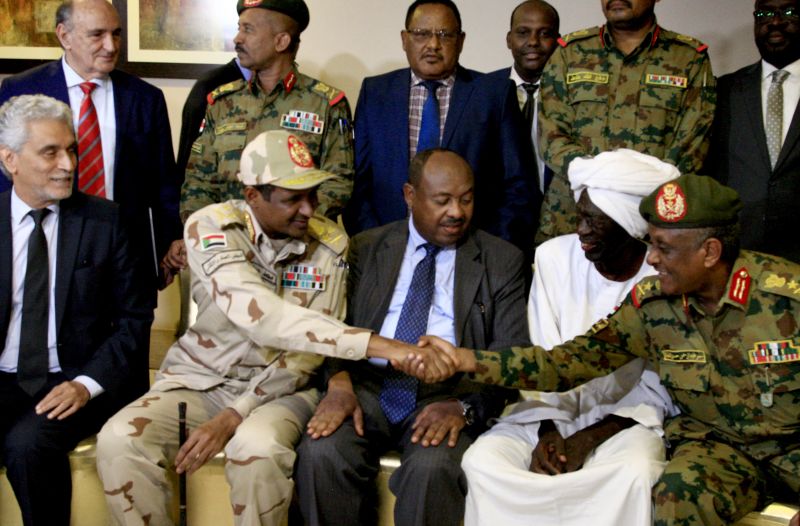
A recent report from the European platform 'Visgard 24' reveals that Sudanese army leader Abdel Fattah Burhan surrounds himself with an ideologically driven army of the Muslim Brotherhood, posing a threat not only to Sudan but also to European capitals through his alliances with Iran.
The report indicates that this ideologically driven army's role extends beyond threatening stability in Sudan; its influence includes exporting extremism to European countries, raising significant concerns among European governments about the growth of this phenomenon.
Details of the Situation
Concerns are growing that Burhan, who took command of the Sudanese army following the ousting of former president Omar al-Bashir, has established alliances with extremist Islamic groups, thereby strengthening his position domestically and increasing his influence in the region. The report highlights how Burhan exploits these groups to bolster his authority, raising questions about Sudan's future and stability.
The report also emphasizes that alliances with Iran could enhance Burhan's ability to export extremism, as Iran is known to support extremist Islamic groups in the region. This cooperation could lead to increased tensions in the Middle East and affect relations between Sudan and Western countries.
Background & Context
Since the ousting of Bashir's regime, Sudan has witnessed a significant transformation in its political landscape, with military forces vying for control of governance. Burhan, regarded as one of the prominent military leaders, seeks to consolidate his power through alliances with Islamic groups, raising fears of a resurgence of extremism in the political arena.
Historically, Islamic groups have always been part of the political landscape in Sudan, but current alliances with Iran could reshape this landscape in a way that threatens regional stability. Additionally, these alliances may escalate internal conflicts in Sudan, complicating the security and economic situation in the country.
Impact & Consequences
The report raises numerous questions about how these alliances will affect regional and international security. As extremism rises, European countries may face new challenges in combating terrorism, necessitating a reassessment of their security strategies.
Furthermore, the export of extremism from Sudan to Europe could lead to heightened tensions within local communities, potentially contributing to the spread of Islamophobia and impacting relations between Muslim communities and Western societies.
Regional Significance
The impact of these alliances is not limited to Sudan alone but extends to neighboring Arab countries. With the increasing influence of Islamic groups, the stability of neighboring nations such as Egypt and Libya may be compromised, further complicating security situations in the region.
These developments could also lead to increased divisions within Arab communities, exacerbating instability and heightening the challenges faced by governments in the region.
In conclusion, the report indicates that the situation in Sudan requires urgent international attention, as current alliances could lead to serious repercussions for regional and international security.