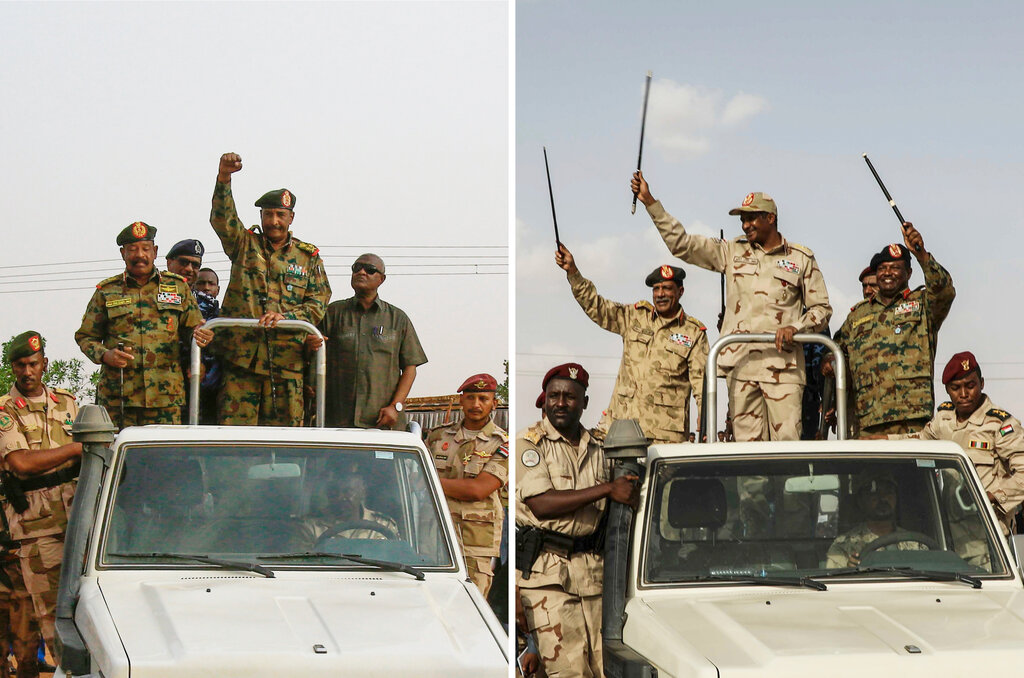
In a bold move aimed at restructuring the armed forces, Sudan's Sovereign Council President, General Abdel Fattah Burhan, issued a decision to abolish the positions of Deputy and Assistant Army Chief. This decision is part of Burhan's efforts to strengthen military control amid the tense situation in Sudan.
According to a statement from the armed forces, the decision stipulates the cancellation of Decision 164 of 2023, which had appointed the Deputy Chief of Staff and Assistant Chiefs of Staff. The statement also indicated that those affected by the annulled decision would remain members of the armed forces leadership, reflecting Burhan's desire to maintain a balance of power within the military institution.
Details of the Decision
In a related context, Burhan also issued a decision to appoint several new assistants. General Shams al-Din Kabbashi Ibrahim Shanto was appointed as Assistant for Construction and Strategic Planning, and General Mirghani Idris Suleiman Idris was appointed as Assistant for Military Industries. Additionally, Engineer Consultant Marine Ibrahim Jaber Ibrahim Karima was appointed as Assistant for International Relations and Military Cooperation.
These changes come after Burhan previously relieved Chief of Staff Mohamed Osman Al-Hussein from his position and retired him, appointing General Yasser Al-Atta as his successor. A new Chief of Staff presidency was formed under Al-Atta, with Abd al-Khayr Abdullah Nasser Dargam appointed as Deputy Chief of Staff, and Mohamed Ali Ahmed Sabir as Head of Military Intelligence.
Background & Context
Since April 2023, Sudan has been experiencing armed conflict between the Sudanese Armed Forces and the Rapid Support Forces, stemming from disagreements over the latter's integration into the military. This conflict has exacerbated humanitarian conditions, with millions of Sudanese suffering from famine and displacement, making the situation in the country among the worst in the world.
Historically, the Sudanese Armed Forces have played a pivotal role in many political transformations in the country, from the 1985 uprising that ousted former President Jaafar Nimeiri to recent events. Burhan emphasized in his statement commemorating the uprising the role of the armed forces as a partner in the state's journey, noting its responsiveness to the people's demands at various historical junctures.
Impact & Consequences
These changes come at a sensitive time, as Burhan seeks to consolidate his military authority in the face of internal challenges. These decisions are expected to affect the balance of power within the army and may lead to further tensions among various military factions.
Moreover, these steps may reflect Burhan's attempt to affirm the loyalty of the armed forces to him amid the increasing crises facing the country. As the conflict continues, the question remains about how these changes will impact the course of events in Sudan.
Regional Significance
The situation in Sudan is of particular importance to the Arab region, as stability in this country directly affects regional security. The ongoing conflict could have negative repercussions for neighboring countries, especially with the influx of refugees and limited resources.
Furthermore, events in Sudan may inspire political movements in other countries, making it essential to closely monitor developments. Amid these circumstances, hope remains for achieving peace and stability in Sudan, which requires concerted international and local efforts.