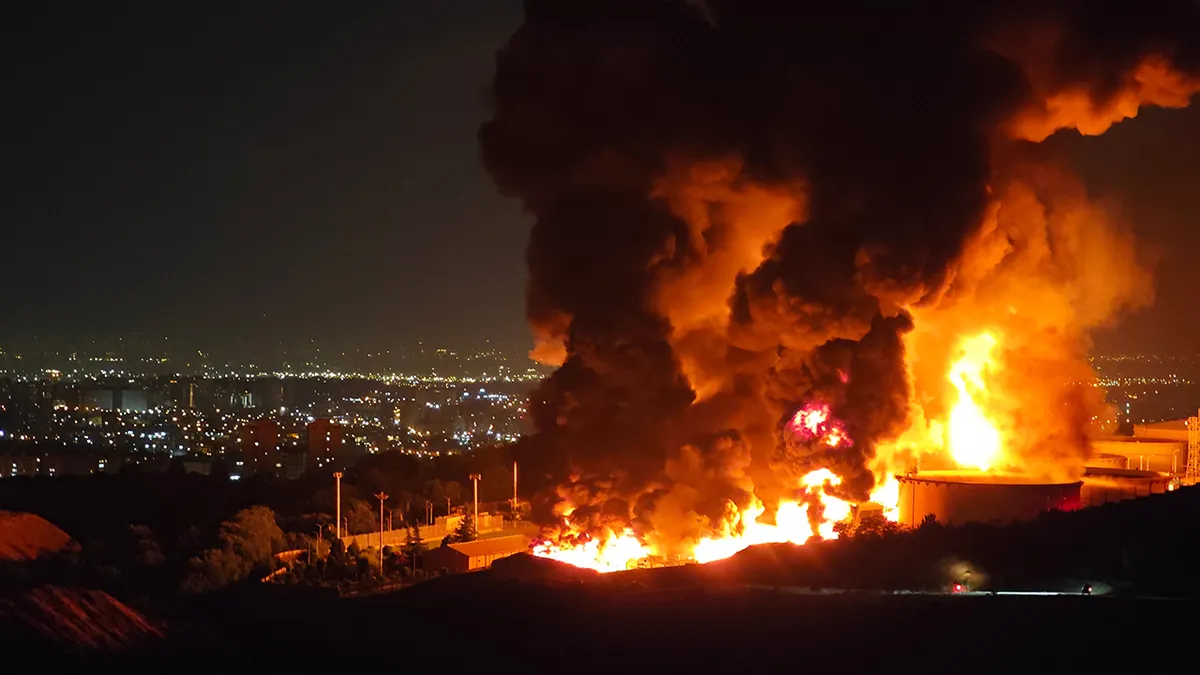
In a new escalation reflecting the increasing precision targeting of Israeli vital facilities, the oil refinery complex in the city of Haifa was subjected to a rocket attack today, believed to have originated from Iran, as part of a wave of rockets aimed at northern Israel. This attack coincided with another barrage of rockets launched by Hezbollah from Lebanon.
The Israeli Fire and Rescue Authority reported two injuries within the refinery complex, one in an industrial building and the other in a fuel tank containing 3,000 cubic meters of gasoline. Field footage showed significant flames erupting from the tank as firefighting teams worked to control the blaze. The authority confirmed that no hazardous material leaks were detected as a result of the attack.
Details of the Incident
Investigations have pinpointed the exact geographical location of the tank that was hit by rocket shrapnel, which is considered one of the operational tanks within the refinery, surrounded by eight other tanks and vital facilities. The Israeli army suspects that a cluster munition was used in these attacks, further escalating the situation's danger.
This incident marks the second time since the onset of the current war that the Haifa refineries have faced attacks from Iran, with shrapnel falling due to the interception of an Iranian missile a week and a half ago, which caused fires that were later extinguished.
Context and Background
These attacks come at a sensitive time, as tensions in the region have notably increased. This repeated targeting has sparked outrage among environmental circles in Israel, with the director-general of the Green Movement, Elad Hochman, criticizing the failure to evacuate the city of Haifa from oil refineries thus far. He pointed out that the delay in evacuating vital facilities represents serious negligence, for which Prime Minister Benjamin Netanyahu, Energy Minister Eli Cohen, and Environmental Protection Minister Idit Silman bear responsibility.
According to Hochman, the continued presence of these facilities in their current location endangers the lives of hundreds of thousands of residents, both in times of peace and war. He also noted that every day of delay in closing the Bazan refinery poses a significant national risk.
Consequences and Impact
The strike on Haifa comes just one day after a missile targeted the Adama chemical plant in the Neot Hovav area near Beersheba, where an Iranian missile caused damage to about 100 homes and a hazardous material leak from within the plant. Israeli authorities rushed to impose a tight security cordon around the plant's vicinity and decided to evacuate the area as a precautionary measure.
This escalation in attacks reflects the increasing tensions in the region and indicates that the conflict may extend beyond traditional boundaries, placing civilians in danger. Furthermore, these attacks could lead to greater military escalation, complicating the security situation in the area.
Impact on the Arab Region
These developments signal a rise in tensions in the Middle East, reflecting ongoing conflicts between regional powers. Targeting vital facilities in Israel may trigger cascading reactions from concerned parties, increasing the likelihood of new conflicts erupting.
Moreover, these events underscore the need for sustainable political solutions to the crises in the region, as the continuation of violence will affect regional security and stability overall.
In conclusion, the situation in Haifa and the region as a whole remains tense, requiring close monitoring by the international community to mitigate conflicts and ensure civilian safety.