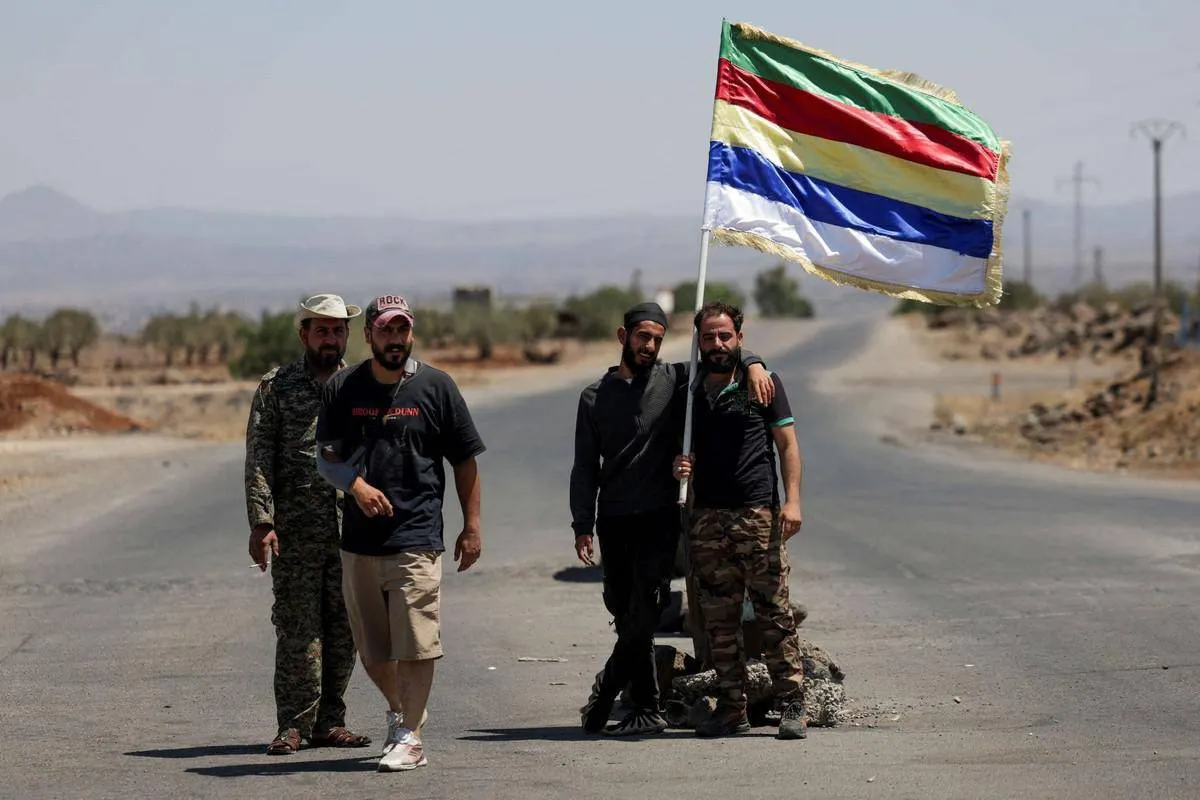
On Tuesday, Sheikh Hikmat Hijri announced the dissolution of the Supreme Legal Committee, appointing Judge Shadi Faiz Murshid to establish what he termed the "Board of Directors in Jabal Bashan." This move has raised questions about Hijri's motives and the possibility of replicating the self-administration experience in other regions of Syria.
A Syrian official source, in a special statement, denied any external attempts to mediate between the Syrian government and Hijri, indicating that this step is part of managing the current phase in the governorate of Sweida, which is suffering from security chaos.
Event Details
Political analysts have varied opinions regarding Hijri's decision. Some consider it a retreat from his previous positions, while others see it as a determination to replicate the self-administration experience that failed in northeastern Syria. In this context, Qutaiba Azam, the Director of Media Relations in Sweida, confirmed that this step could lead the locals into uncertainty and increase their suffering.
Azam added that Hijri's areas of influence are plagued by lawless groups, noting that these groups have hijacked the decision-making in Sweida and continue to commit violations. He emphasized that a significant number of the people of Jabal al-Arab condemn these actions and demand the Syrian state to intervene.
Background & Context
The Supreme Legal Committee was established in August 2025 following clashes in Sweida, aiming to manage the governorate's affairs away from the Syrian government. However, the committee has made little progress, and living and security conditions in the region have worsened. Recently, an armed group stormed the Education Directorate building in Sweida, heightening concerns in the governorate.
These developments come at a time when locals are suffering from worsening economic and service crises, amid a sharp division regarding the stance towards the Syrian government. A political analyst described the situation in Sweida as "very dire," pointing out that the political activity of national elites has diminished due to arrests.
Impact & Consequences
Hijri's move could escalate tensions in Sweida, as some view it as an attempt to absorb public anger. Others indicate that Hijri is seeking to renew the self-administration project, despite the current conditions not supporting its success. Analysts believe this step may represent a repositioning, as it has been less confrontational towards the government.
In this context, writer and rights activist Muhammad Sabra believes that the self-administration experience in northeastern Syria could not withstand the new changes, noting that Sweida lacks the natural resources that could support such a project.
Regional Significance
The repercussions of this decision extend beyond Sweida, reflecting a state of chaos and instability experienced by many Syrian regions. These conditions may affect the relationship between the Syrian government and local communities, complicating the political landscape in the country.
In conclusion, the question remains about the future of Sweida in light of these developments, and whether the Syrian government will intervene to assert its sovereignty and restore security in the region.