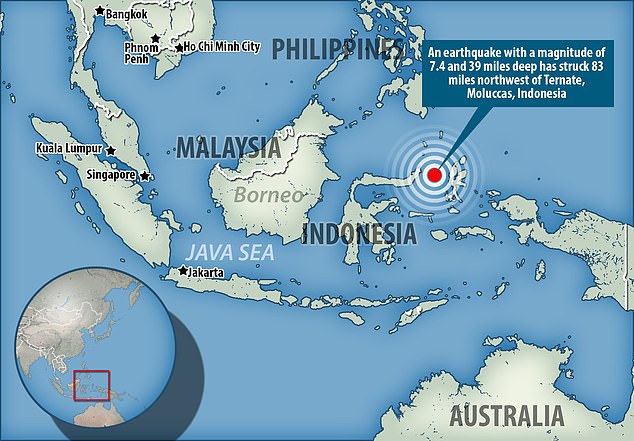
A powerful earthquake measuring 7.6 on the Richter scale struck the city of Beitung in Indonesia, triggering small tsunami waves in some coastal areas. The earthquake occurred at 05:48 AM local time at a depth of 62 kilometers, with its epicenter located offshore near the city.
According to statements from Abdullah Mahari, head of the Data, Information, and Communication Center at the Indonesian National Disaster Management Agency, tsunami waves of 0.3 meters were recorded in the West Halmahera area about twenty minutes after the earthquake, and a height of 0.2 meters in Beitung.
Details of the Event
Residents of Beitung felt strong tremors lasting between 10 to 20 seconds, causing panic among the population who rushed out of their homes. The earthquake was also felt in other areas such as the city of Ternate, increasing anxiety among residents.
After the main earthquake, two additional quakes were recorded measuring 5.5 and 5.2, but there were no tsunami warnings issued as a result of these quakes. Initial reports indicated light to moderate damage in Ternate, including damage to a place of worship and several homes.
Background & Context
Indonesia is considered one of the most earthquake-prone countries due to its location on the Ring of Fire in the Pacific, where several tectonic plates meet. Historically, the country has experienced many devastating earthquakes, such as the Sumatra earthquake in 2004, which resulted in catastrophic tsunami waves. These events highlight the importance of early warning systems and disaster preparedness in the country.
The Indonesian government is working to enhance its disaster management capabilities, including improving early warning systems and educating the public on how to act in emergencies. However, challenges remain, especially in remote areas.
Impact & Consequences
These natural disasters can lead to significant economic and social impacts, potentially destroying infrastructure and affecting people's lives. The panic that ensues among residents after earthquakes can also lead to long-term psychological consequences.
Immediate response from the government and local agencies requires swift measures to ensure the safety of residents and provide necessary assistance. It is also crucial to accurately assess the damage to ensure effective reconstruction.
Regional Significance
While this event may seem distant from the Arab region, earthquakes and natural disasters remain a topic of global importance. These events remind us of the need to enhance international cooperation in disaster management and the exchange of modern information and technologies.
Preparedness for natural disasters is also part of sustainable development strategies, which should be at the core of concerns for Arab countries as well.