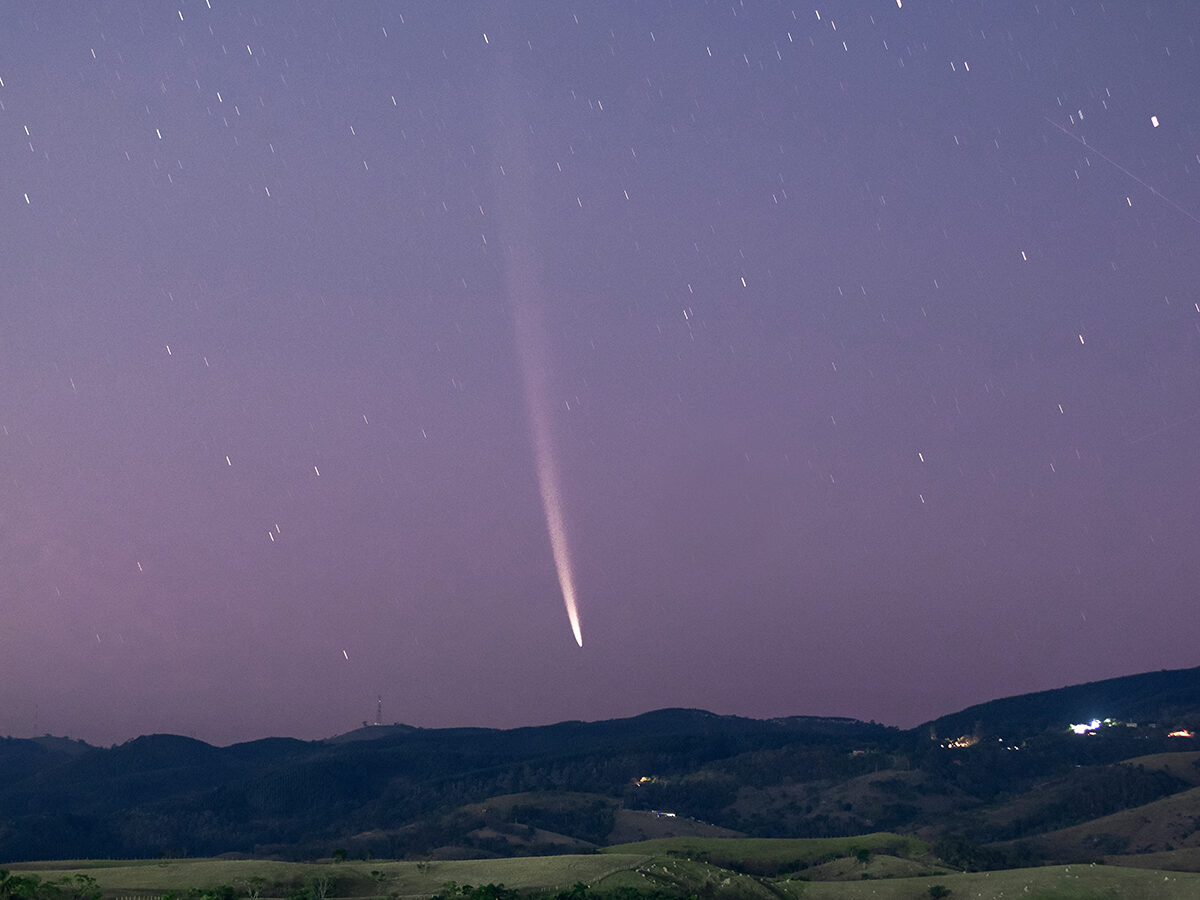
In a rare astronomical event, the brightest comet of the year, named 'C/2023 A3', vanished after its close approach to the sun, capturing the attention of scientists and astronomy enthusiasts worldwide. The comet had been observed by telescopes before its sudden disappearance.
This comet, considered one of the brightest in recent years, approached the sun earlier this month, providing scientists with an opportunity to study it closely. However, its proximity to the sun caused a significant portion of its material to evaporate, leading to its disappearance from view.
Details of the Event
The comet 'C/2023 A3' was discovered in January 2023, and it was expected to be visible to the naked eye in some regions. As it approached the sun, predictions indicated that it could be one of the brightest comets in modern history. However, as the time for its appearance drew near, reports began to suggest a deterioration in its condition.
When the comet neared the sun, it was subjected to intense heat, causing a large part of its nucleus to disintegrate. This disintegration resulted in its disappearance from view, as it could no longer be tracked by ground-based telescopes. Scientists are now in a state of astonishment, as they were looking forward to studying this comet closely.
Background & Context
Comets are celestial bodies composed of ice and dust, considered remnants of the solar system. Historically, comets were viewed as omens of significant events and were often associated with spiritual and religious concepts. In recent years, the importance of studying comets has increased, as they can provide valuable information about the formation of the solar system.
Historically, Earth has witnessed many prominent comets, such as Halley's Comet, which appears every 76 years. However, modern comets like 'C/2023 A3' demonstrate how rapidly astronomical conditions can change, making the study of these phenomena even more critical.
Impact & Consequences
The disappearance of comet 'C/2023 A3' raises questions about how astronomical conditions affect celestial bodies. Scientists are now studying how the heat generated by the sun can impact other comets and whether this phenomenon will recur with other celestial objects in the future.
This event also reflects the importance of modern technology in monitoring celestial bodies. Advanced telescopes and computer programs allow scientists to observe comets and predict their behavior, enhancing our understanding of the universe.
Regional Significance
In the Arab world, the disappearance of the comet has sparked significant interest among astronomy enthusiasts. Many Arab countries have astronomical programs aimed at promoting scientific awareness among youth. This event could be used as an opportunity to encourage further research and studies in the field of astronomy.
Additionally, this event could enhance cooperation among Arab countries in the fields of science and technology, as knowledge and expertise in studying celestial bodies can be shared.
In conclusion, the disappearance of comet 'C/2023 A3' represents an opportunity to reflect on how astronomical phenomena impact our planet and the importance of scientific research in understanding these phenomena.