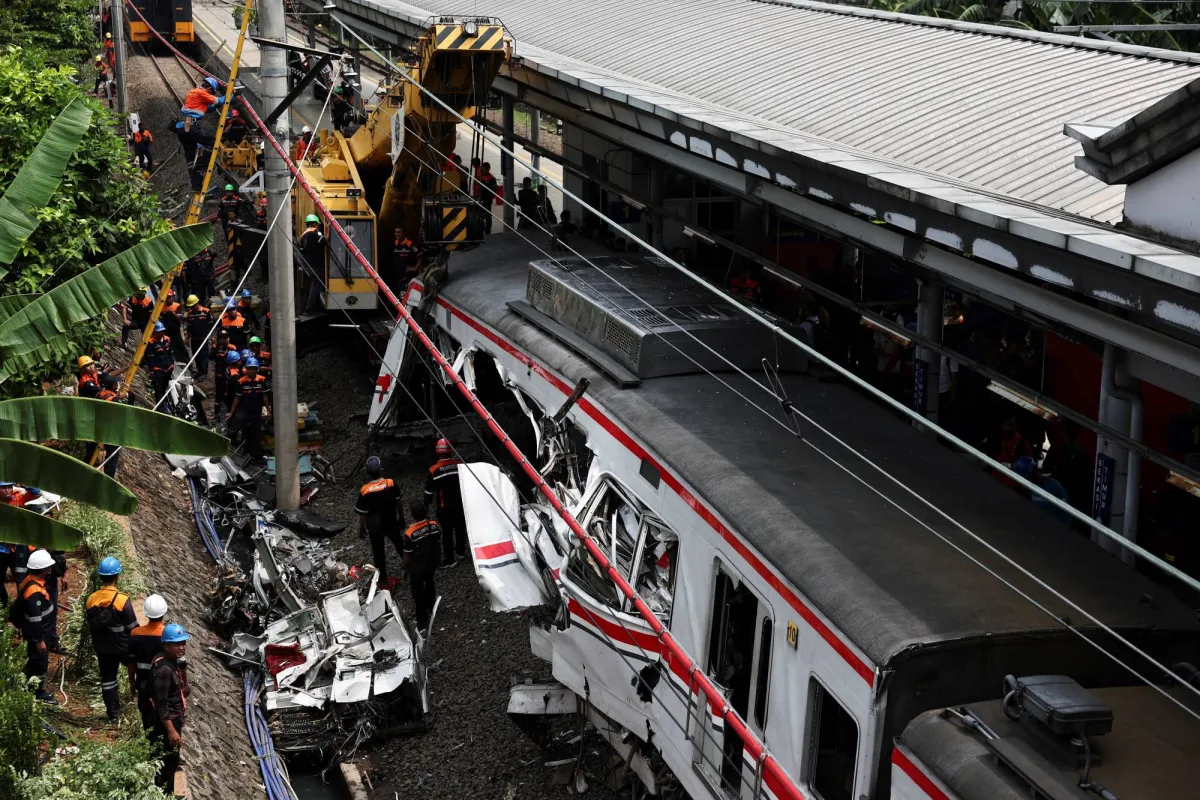
The death toll from the collision of two trains near the Indonesian capital Jakarta has risen to 14, while 84 others were injured in the incident that occurred late Monday. The accident took place between a passenger train and a long-distance train in the Bekasi area, leading to panic and chaos at the scene.
Rescue teams are working to extract survivors who remain trapped in the debris. Reports indicate that rescuers managed to separate the two trains and used specialized tools to cut through metal to reach the victims.
Details of the Incident
The collision occurred near the Bekasi Timur station, which is about 25 kilometers from Jakarta. The spokesperson for the state railway company, Ann Borba, confirmed that the accident initially resulted in two fatalities, but the numbers rose later as rescue operations continued.
Television footage showed ambulances arriving at the scene, where the injured were transported on stretchers to nearby hospitals. The railway operator confirmed that several passenger train services were canceled due to the accident.
Background & Context
Railway accidents are common in Indonesia, where the country suffers from a lack of maintenance and modernization in transportation. In recent years, Indonesia has witnessed several deadly incidents, including a collision in West Java province in 2024 that resulted in the deaths of four people.
Historically, Indonesia faces significant challenges in transportation, often with buses and trains being old and unfit for use. In 2015, 16 people died as a result of a collision between a passenger train and a minibus at a railway crossing in Jakarta.
Impact & Consequences
These incidents raise questions about the safety of the railway system in Indonesia, necessitating comprehensive investigations to improve safety standards. The National Transportation Safety Committee has opened an investigation into the current accident, indicating the importance of taking immediate action to prevent the recurrence of such incidents.
These accidents also require a swift response from the government to improve infrastructure and modernize transportation, as Indonesia is one of the largest countries in Southeast Asia and must have safe and efficient transport systems.
Regional Significance
These incidents highlight the importance of improving safety standards in transportation, a concern for many Arab countries facing similar challenges in this area. Arab nations can benefit from Indonesia's experiences in developing effective strategies to enhance transportation systems.
In conclusion, the current situation in Indonesia requires more international and local attention to ensure citizen safety and improve transportation quality, reflecting the importance of investing in infrastructure.