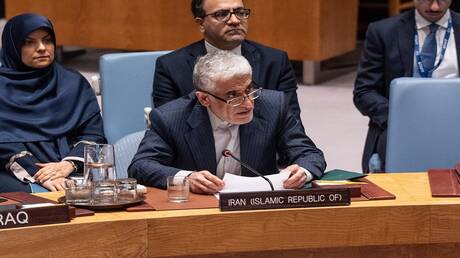
Iran's representative to the United Nations, Amir Saeed Iravani, asserted that President Donald Trump's acknowledgment of arming hostile groups is clear evidence of his intention to transform peaceful protests into acts of violence and bloodshed. This statement arises at a time when the region is experiencing increasing tensions, with growing concerns over escalating violence amid political and social crises.
Iravani pointed out that this admission reflects the United States' policy aimed at destabilizing the region, emphasizing that arming hostile groups only exacerbates conditions and increases divisions. He also called on the international community to take a firm stance against these policies that threaten regional peace and security.
Details of the Event
In remarks made during a Security Council session, Iravani confirmed that arming hostile groups constitutes a violation of international laws and reflects the United States' intention to interfere in the internal affairs of other countries. He explained that this behavior contributes to fueling conflicts and increases the suffering of peoples.
He also noted that Iran has long warned of the repercussions of these policies, stressing the importance of dialogue and understanding as a means to resolve disputes. He considered the American acknowledgment as evidence of the failure of U.S. policies in the region, which have only led to more chaos and instability.
Background & Context
Historically, the United States has often been accused of supporting opposition groups in various countries, leading to exacerbated crises. In recent years, the Arab region has witnessed numerous popular protests that began peacefully, but external interventions have led to their transformation into violent acts.
Iran, which sees itself as a victim of these policies, seeks to strengthen its position on the international stage by highlighting these violations. The past few years have seen escalating tensions between Iran and the United States, impacting relations among countries in the region.
Impact & Consequences
Trump's acknowledgment of arming hostile groups could lead to heightened tensions in the region, as armed groups may exploit this support to enhance their capabilities. Furthermore, this could contribute to increasing divisions among countries, making it difficult to achieve stability.
Moreover, this acknowledgment may affect relations between the United States and its allies in the region, potentially causing a loss of trust among the involved parties. At the same time, it may lead to escalated reactions from countries that perceive themselves as threatened by these policies.
Regional Significance
In the Arab context, this acknowledgment could raise concerns among countries facing internal conflicts, as it may encourage armed groups to adopt more extremist positions. Additionally, this could impact peace efforts in areas like Syria and Yemen, where armed groups seek to achieve their goals through violence.
In conclusion, the question remains about how the international community will respond to these American policies and whether there is a possibility for genuine dialogue that contributes to ending conflicts and achieving peace in the region.