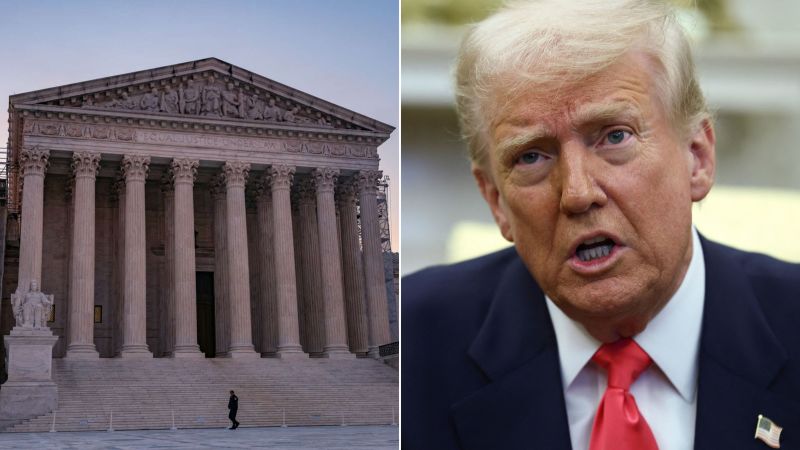
U.S. President Donald Trump is preparing to attend a session of the U.S. Supreme Court today, making him the first sitting American president to be present for oral arguments before the highest court in the country. The session pertains to Trump's appeal against a ruling from a lower court that invalidated his executive order restricting the right to citizenship by birth.
The executive order signed by Trump at the beginning of his second term states that children born to undocumented or temporary parents in the United States are not considered American citizens. This approach represents a radical shift from the prevailing interpretation that the 14th Amendment of the U.S. Constitution grants citizenship to anyone born on U.S. soil, with limited exceptions.
Details of the Event
The official agenda for the Republican president includes a stop at the Supreme Court, where the justices will hear Trump's arguments. The case concerning "birthright citizenship" has sparked widespread debate in the United States, with many politicians and academics viewing it as a step contrary to the Constitution, potentially impacting large numbers of children born annually in the country.
The 14th Amendment, ratified in 1868 after the Civil War, guarantees the right to citizenship by birth. The citizenship clause states that "all persons born or naturalized in the United States, and subject to the jurisdiction thereof, are citizens of the United States." This means that anyone born within U.S. territory, with the exception of children of foreign diplomats, is automatically considered an American citizen.
Background & Context
Historically, the 14th Amendment was adopted to ensure citizenship rights for former slaves, overturning the Supreme Court's decision in the Dred Scott case, which denied African Americans citizenship. Trump and his legal team argue that the phrase "subject to the jurisdiction thereof" requires complete political allegiance, which they claim is not present among illegal immigrants, and thus their children do not deserve automatic citizenship.
However, most constitutional law experts and historians believe that this interpretation contradicts the spirit of the Constitution, which aims to ensure that no group is deprived of rights based on their parents' status. Trump is relying on the "judicial revolution" he has initiated by appointing conservative justices to the Supreme Court, hoping that this new composition will be willing to reconsider historical precedents.
Impact & Consequences
The Supreme Court now faces two options: either issue a comprehensive constitutional ruling that resolves the issue permanently, or choose a "narrower" path focusing on the fact that the Immigration and Nationality Act of 1952 enshrined this right independently of the Constitution. This option implies that the president does not have the authority to revoke a law passed by Congress merely through an executive order, making Trump's attempt a "unilateral circumvention" illegal.
The Washington Post emphasizes that reviewing a policy that has been stable for decades requires compelling historical evidence, which they see as absent or conflicting in the arguments presented by Trump's team. This case represents a turning point in the debate over immigration and citizenship in the United States.
Regional Significance
This case is significant for the Arab region, where issues of immigration and citizenship are of great concern. Trump's immigration policies may affect many Arabs residing in the United States, especially those seeking citizenship. Furthermore, the discussion surrounding immigrant rights and citizenship reflects larger challenges faced by many Arab countries in the context of conflicts and migration.
In conclusion, Trump's attendance at the Supreme Court session marks an unprecedented step, reflecting the political and constitutional tensions in the United States, and highlighting immigration and citizenship issues that continue to occupy public opinion.