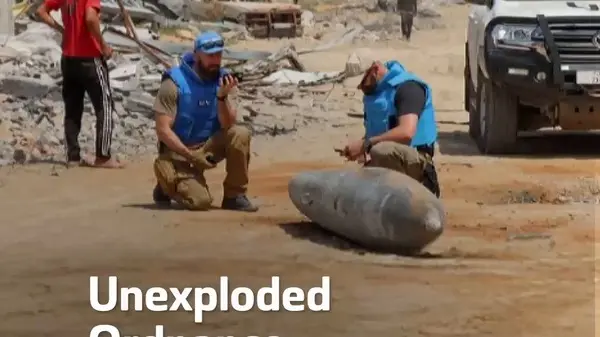
The United Nations has issued a warning regarding the Gaza Strip, which has suffered massive destruction due to ongoing conflicts, facing a serious issue with large quantities of unexploded ordnance. This ordnance poses a danger to civilian lives, having caused fatalities and severe injuries, complicating the reconstruction efforts pursued by both international and local organizations.
Reports indicate that unexploded ordnance not only represents a direct threat to individuals but also obstructs rebuilding and development operations in the region. With the presence of these munitions, humanitarian organizations and local communities find it challenging to carry out reconstruction safely and effectively.
Details of the Situation
In its latest report, the United Nations confirmed that many areas in Gaza still contain unexploded ordnance as a result of previous conflicts. This ordnance includes artillery shells and bombs that did not detonate, remaining buried in the ground and posing a constant threat to civilians, especially children who may be at risk while playing or searching for usable materials.
The UN is working with local authorities and non-governmental organizations to conduct clearance operations in the area, but the process faces significant challenges due to the complex security and political conditions in Gaza. Officials have indicated that these efforts require greater international support to be effective.
Background & Context
The Gaza Strip has witnessed several wars and conflicts over the past years, leading to widespread destruction of infrastructure and vital facilities. After each conflict, there have been efforts to rebuild, but the presence of unexploded ordnance represents a major obstacle to these initiatives. The history of conflicts in Gaza spans decades, with each round of violence leaving devastating impacts on the population and infrastructure.
Gaza is considered one of the most densely populated areas in the world, complicating the situation further. With a large population residing in small areas, any security threat such as unexploded ordnance can have devastating effects on the daily lives of civilians.
Impact & Consequences
Unexploded ordnance poses a threat not only to individuals but also to the reconstruction and economic development process in Gaza. With the continued presence of these munitions, attracting investments and international aid becomes increasingly difficult, exacerbating economic and social conditions.
Moreover, the persistence of this issue could lead to rising feelings of frustration and despair among the population, increasing the likelihood of new conflicts erupting. Therefore, addressing this issue is essential for achieving stability in the region.
Regional Significance
The issue of unexploded ordnance in Gaza exemplifies the challenges faced by many Arab countries suffering from conflicts. Tackling these issues requires a concerted effort from both international and local entities to ensure civilian safety and achieve sustainable development.
The situation in Gaza highlights the importance of international support in reconstruction efforts, as any delay in addressing these issues could worsen the humanitarian conditions in the region.
Addressing the problem of unexploded ordnance in Gaza is not merely a security issue but a humanitarian necessity that contributes to achieving peace and stability in the region. International efforts need to focus on this issue to ensure a better future for the residents of Gaza.