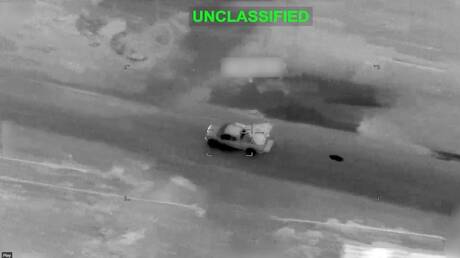
The US Central Command, known as CENTCOM, has published a video showcasing airstrikes that targeted Iranian military sites and infrastructure, describing the operation as aimed at "neutralizing the capabilities of the Iranian army." These strikes occur at a sensitive time marked by rising tensions between the United States and Iran in the Middle East.
The footage shared on social media displays warplanes targeting a range of Iranian military sites, reflecting the United States' strategy to counter Iranian activities in the region. These strikes have elicited mixed reactions from various stakeholders involved.
Details of the Airstrikes
The airstrikes executed by CENTCOM involved targeting several Iranian military facilities believed to be used for weapon development and troop training. These operations were conducted with high precision, aiming at sites far from residential areas to minimize collateral damage.
These operations are part of the United States' policy towards Iran, which seeks to diminish its influence in the region, especially following a series of attacks targeting American forces in Iraq and Syria. CENTCOM has confirmed that these strikes are part of its ongoing efforts to maintain regional security.
Background & Context
Historically, relations between the United States and Iran have been marked by increasing tensions, particularly after Washington's withdrawal from the Iranian nuclear agreement in 2018. Since then, the United States has imposed stringent economic sanctions on Iran, significantly impacting its economy.
In recent years, Iranian military activities in the region have intensified, including support for armed groups in Iraq, Syria, and Lebanon. These activities have prompted the United States to bolster its military presence in the region, increasing the likelihood of military escalation.
Impact & Consequences
These strikes could escalate tensions between Iran and the United States, potentially negatively affecting regional security. Possible Iranian reactions may include increased military activities or attacks on American forces in the region.
Furthermore, these events may influence the relationships between the United States and its allies in the Middle East, as some allies may express concern over the potential for military escalation. Additionally, these strikes could provoke responses from other regional powers, such as Russia and China, which may support Iran in facing American pressures.
Regional Significance
These strikes are part of the broader conflict between major powers in the Middle East, directly affecting Arab countries. Increased tensions could destabilize the region, impacting security and economies in neighboring states.
Moreover, these events may reopen discussions about the role of the United States in the region and its influence on local and regional policies. At the same time, armed groups in the region might exploit these events to justify escalating their activities against American forces or their allies.
In conclusion, developments in this context remain under observation, as any further escalation could impact regional security and reshape alliances in the Middle East.