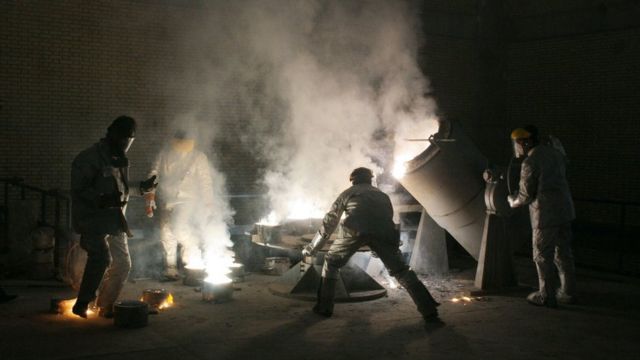
The United States is considering the option of executing a military operation to extract Iranian highly enriched uranium, a complex path fraught with field, intelligence, and logistical challenges that could make this mission one of the most difficult military operations of contemporary times.
Despite Washington's announcement in June 2025 regarding the destruction of the Iranian nuclear program, the stockpile of enriched uranium still exists. Estimates from the International Atomic Energy Agency indicate that Tehran possesses approximately 440 kilograms of uranium enriched to 60%.
Details of the Operation
It is believed that Iran has redistributed this stockpile after the U.S. strike on three major facilities: Fordow, Isfahan, and Natanz, with indications of quantities in other secret locations, complicating any attempt to access it. According to a report broadcast by Al Jazeera journalist Mahmoud Al-Kin, any potential U.S. operation may require the deployment of around 1,000 special forces personnel inside Iranian territory, marking one of the largest operations of this kind.
However, this scenario faces significant obstacles, starting with the need to impose a wide security cordon around the storage sites. Iran has the capability to target those forces with missiles and drones from the very first moment.
Context and Background
The field challenges are numerous, as it is likely that the uranium is stored deep underground, beneath layers of rock and debris resulting from previous strikes. This necessitates excavation operations that could take days, meaning that forces would remain on the ground for extended periods under direct threat.
Reports warn of the possibility of some storage facilities being rigged, where a single explosion could permanently close tunnels and bury materials within fortified facilities. Additionally, the risks associated with inaccurate intelligence regarding the actual storage locations could complicate matters further.
Technical Challenges and Consequences
If access to the stockpile is achieved, the forces face another technical challenge in dealing with massive cylinders that may weigh over one to three tons, requiring special equipment for transport. Moreover, it is crucial to avoid any leakage of radioactive and toxic materials, as specialized teams in weapons of mass destruction would be responsible for inspection, packaging, and securing.
The operation becomes even more complicated with the potential for radioactive or chemical contamination, whether during transport or if a decision is made to destroy the stockpile on-site, necessitating precise preparations and responses.
Impact on the Arab Region
The withdrawal phase itself imposes significant logistical challenges, as transporting these loads requires heavy cargo planes such as the C-17, necessitating the securing of a nearby runway or the construction of a temporary runway that could take days to build, alongside providing continuous air cover and protection.
In light of these factors, the operation, if executed, appears to be a race against time in a hostile environment, where combat, technical, and intelligence risks intertwine, and its complexities multiply if the stockpile is distributed across several locations within Iran.