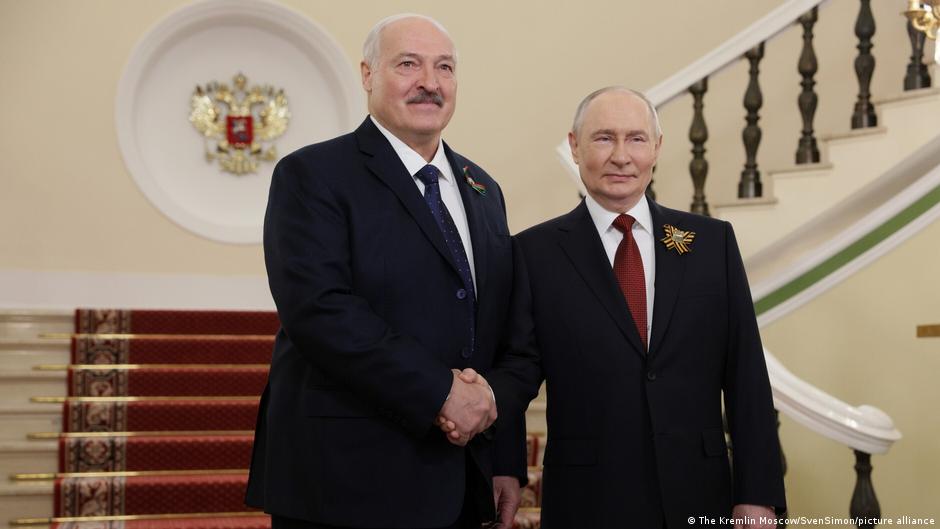
The Belarusian Ministry of Defense announced on Monday the commencement of military exercises involving the use of Russian nuclear weapons, which has sparked a wave of condemnation from Ukraine. These drills occur at a sensitive time as Russia continues to escalate tensions in the region, one year after its full-scale invasion of Ukraine.
In 2023, Belarusian President Alexander Lukashenko agreed to host Russian tactical nuclear missiles, reflecting the depth of military cooperation between Minsk and Moscow. Russian President Vladimir Putin has emphasized that Moscow retains full control over the use of these missiles.
Details of the Military Exercises
A statement from the Belarusian Ministry of Defense confirmed that the drills aim to test the country's readiness to deploy nuclear weapons in various locations. The ministry explained that the exercises will involve cooperation with the Russian side, where the practice of delivering and preparing nuclear munitions for use is scheduled.
The ministry also noted that the drills will focus on practicing stealth, long-distance movement, and calculations for the use of forces and equipment. However, the ministry stressed that these exercises are not directed against any other country and do not pose a threat to regional security.
Background & Context
Historically, Belarus has always been under the influence of Russia, sharing borders with both Russia and Ukraine, as well as three NATO member states. In 2024, the Kremlin issued a revised nuclear doctrine placing Belarus under the Russian nuclear umbrella, complicating the security situation in the region.
This military cooperation between Russia and Belarus comes at a sensitive time as Ukraine continues to face Russian threats. Ukrainian President Volodymyr Zelensky has warned that Moscow seeks to draw Belarus deeper into the war against Ukraine, increasing the risk of military escalation in the region.
Impact & Consequences
These drills are seen as an escalatory step by Russia, aiming to bolster its military presence in the region. The Ukrainian Foreign Ministry condemned the exercises, urging Western allies to impose further sanctions on Russia and Belarus.
Ukrainian officials described this move as a dangerous precedent, as turning Belarus into a nuclear base near NATO borders legitimizes the global proliferation of nuclear weapons, threatening both regional and international security.
Regional Significance
The Arab region is indirectly affected by these developments, as rising tensions in Europe could impact regional stability. Any military escalation may lead to increased energy prices, affecting Arab economies that heavily rely on oil exports.
In light of these circumstances, Arab countries must closely monitor developments in Europe, as any escalation could impact their economic and security interests.