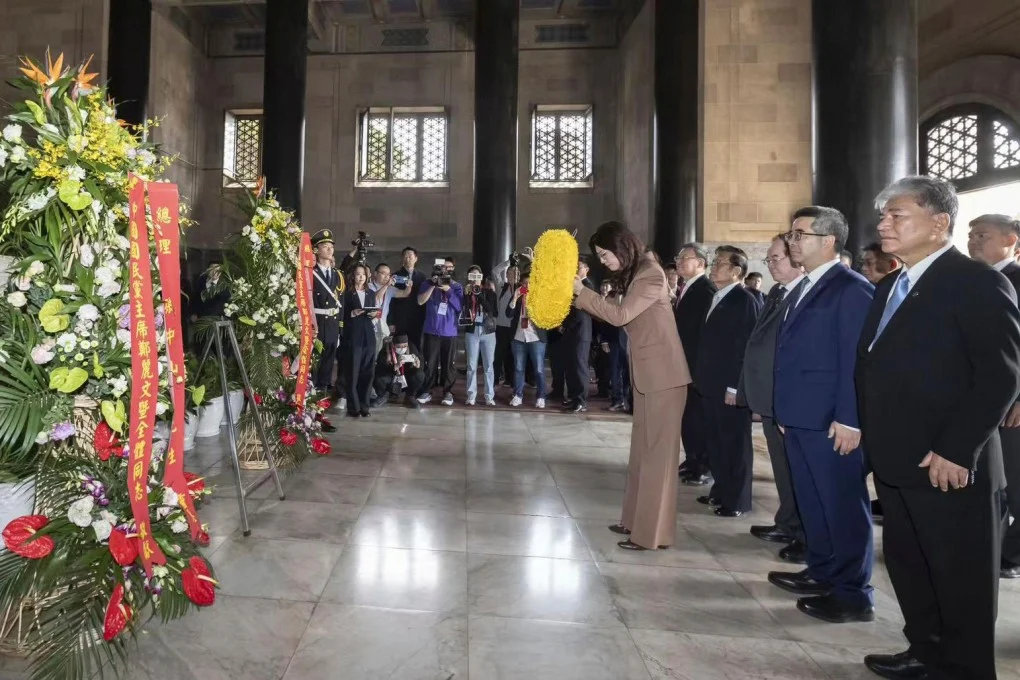
In a powerful speech, Taiwanese opposition leader Cheng Li-wen accused Japanese imperial forces of fragmenting China from Taiwan during a memorial for Chinese revolutionary Sun Yat-sen in Nanjing. She emphasized that Taiwan became a Japanese colony after China's defeat in the First Sino-Japanese War in 1895.
Cheng, who heads the Chinese Nationalist Party (Kuomintang), pointed out that the Japanese occupation of Taiwan was a direct result of the weakness China experienced during that period, contributing to the formation of Taiwanese national identity and creating a historical divide between the mainland and Taiwan.
Details of the Memorial
During a solemn ceremony, Cheng Li-wen laid a wreath at the statue of Sun Yat-sen, a symbol of modern Chinese revolution. In her speech, she asserted that imperial forces were behind many of the tragedies China suffered, including the division of the nation, noting how these forces exploited China's vulnerable situation for their own interests.
Cheng also addressed the importance of national unity, stressing the need for the Taiwanese people to unite with the mainland to face current challenges, expressing her hope to overcome historical divisions and build a shared future.
Background & Context
Historically, China suffered significant weakness during the 19th century, facing military defeats against Western powers and Japan. The First Sino-Japanese War (1894-1895) was a turning point, leading to China losing Taiwan to Japan, with the occupation lasting until the end of World War II, leaving deep impacts on Taiwan's cultural and political identity.
After the end of Japanese occupation, the Chinese Nationalist Party regained control of Taiwan, but political events led to the division of the country into two different political systems: the communist regime on the mainland and the democratic system in Taiwan, a division that continues to affect relations between the two sides today.
Impact & Consequences
Cheng's statements come at a sensitive time as tensions between China and Taiwan escalate, particularly with increased Chinese military activities near Taiwan. These remarks may inflame national sentiments on both sides, complicating the existing situation. They also reflect the current political trends in Taiwan, where the Nationalist Party seeks to strengthen an independent Taiwanese identity, while the Chinese government views Taiwan as an integral part of its territory, intensifying tensions between the two sides.
As the geopolitical landscape shifts, the implications of Cheng's speech could resonate beyond Taiwan, influencing regional dynamics and international relations.
Regional Significance
The ongoing tensions between China and Taiwan are not only a matter of national identity but also a reflection of broader geopolitical struggles in the Asia-Pacific region. Cheng's remarks underscore the historical grievances that continue to shape the relationship between the two entities.
In conclusion, the historical context of Taiwan's colonial past and the current political climate highlight the complexities of cross-strait relations, making Cheng's call for unity particularly significant in the face of rising tensions.