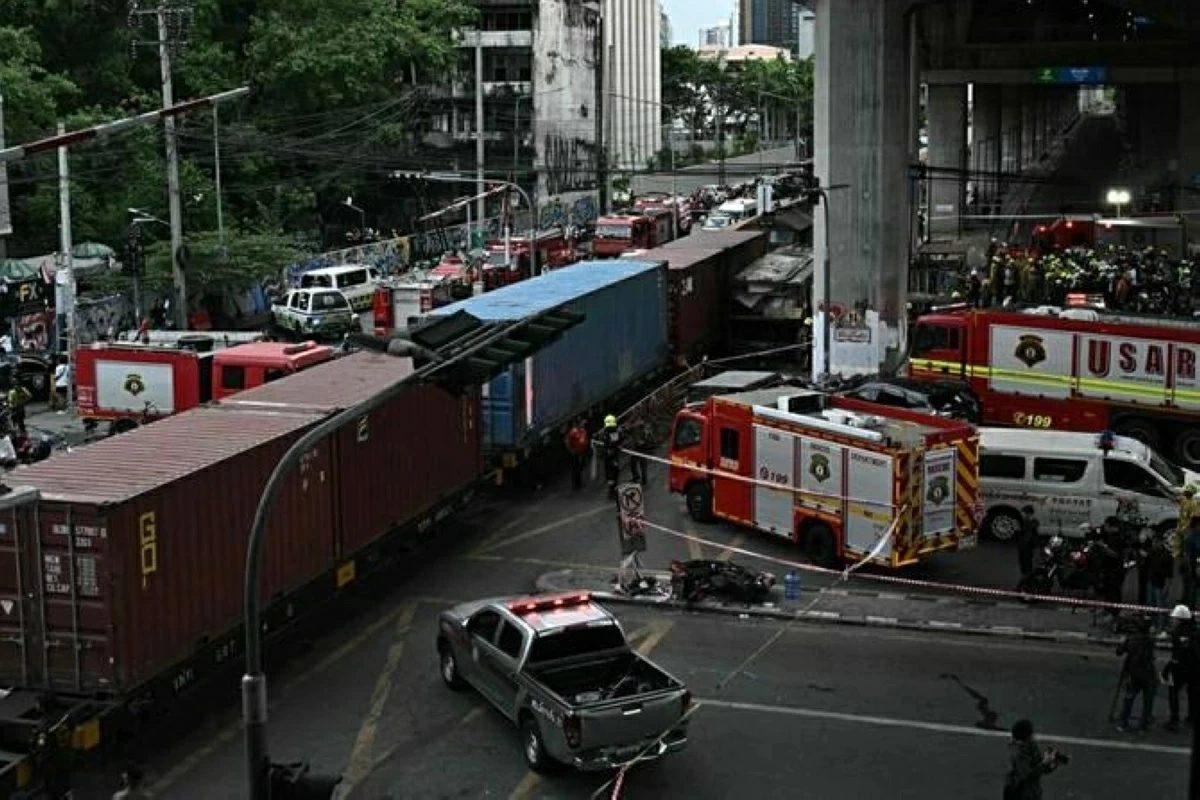
Thai authorities announced yesterday (Monday) that a drug test on the freight train driver involved in a collision with a passenger bus in the capital Bangkok was positive. This tragic incident resulted in the deaths of 8 people and injuries to dozens, leading to charges of reckless driving against the driver.
According to the Saudi Gazette, the accident occurred on Saturday night at the vital "Ashok Din Daeng" railway crossing, where the train struck a public transport bus that had been forced to stop on the tracks due to traffic congestion. This situation prevented the security barriers from closing properly, causing a fire to break out in the bus immediately.
Details of the Incident
Local police chief Oromporn Koundigsomrit reported to AFP that formal charges were filed on Sunday against the train driver (who was injured in the incident) and the crossing guard for negligence leading to death and injury, which both denied.
Oromporn explained that the preliminary urine test of the driver showed the presence of unspecified narcotics, indicating that investigations will also include testing the substitute driver and the technician on board the train.
Background & Context
Bangkok police chief Siang Bunsom stated that the crossing experiences severe daily congestion without any previous recorded accidents. He confirmed that a review of surveillance cameras revealed serious gaps; the crossing guard was seen raising a red flag as a warning signal, yet the train continued without stopping or slowing down.
He added that it is customary at this location for train movement to stop based on the guard's signal until the vehicles blocking the track are cleared. He noted that investigations are ongoing to determine the train's speed and the distance required for braking.
Impact & Consequences
In an engineering analysis, the president of the Structural Engineers Association of Thailand, Dr. Amorn Piemarnmas, estimated that over 100,000 vehicles cross this junction daily, highlighting the dangerous traffic behaviors there, especially motorcyclists bypassing security barriers to avoid waiting.
Amorn concluded by pointing out a planning dilemma; this railway was built decades before the surrounding roads were constructed, and with the urban expansion of the capital, residents have developed what is termed "Risk Normalization"—the transformation of danger into a daily routine that leads people to believe that everything will go smoothly each time, until they wake up to a disaster like the one that occurred.
Regional Significance
This incident underscores the importance of planning and safety in the construction and operation of public transportation, especially in crowded areas.
It can be said that this incident serves as a warning to all Arab countries suffering from severe traffic congestion, where authorities must take immediate action to improve safety and organization on roads and railways.
Conclusion
The report concluded with a commentary on the importance of planning and safety in the construction and operation of public transportation, particularly in densely populated areas.