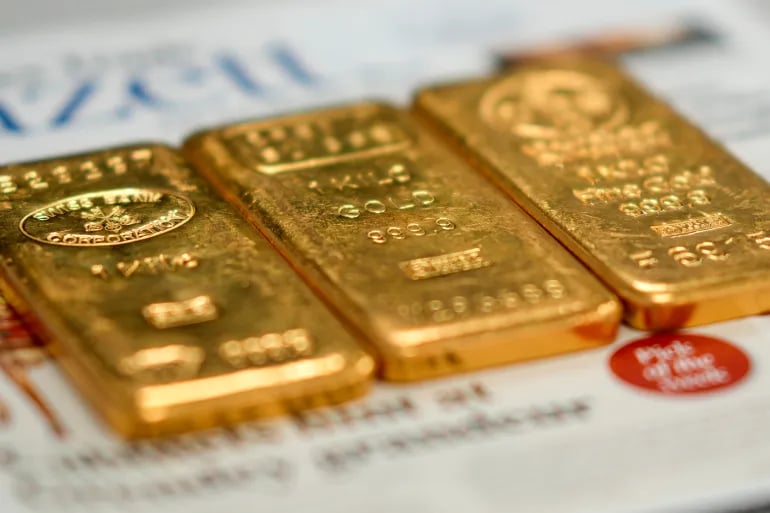
Gold prices decreased during trading on Monday, as markets reacted to increasing expectations for tighter monetary policy in the United States following a strong jobs report. At the same time, rising geopolitical tensions in the Middle East led to an increase in oil prices, heightening concerns about inflation.
The dollar index, which measures the performance of the U.S. currency against a basket of six major currencies, remained stable at 100.00 points after touching 100.17 points. With the U.S. dollar stabilizing, precious metals markets faced selling pressure, resulting in a collective decline in prices.
Details of the Event
The price of gold in futures contracts (August delivery) fell by $29.90 (a decrease of 0.70%), reaching $4335.40 per ounce. Additionally, gold's losses in spot trading deepened by 0.95%, losing $42.11 of its value to settle at $4286.34.
This downward trend extended to other precious metals, with silver in futures contracts (July delivery) declining by 2.00%, down $1.38 to settle at $67.72. Spot silver also fell by $1.31 (or 1.95%), reaching $66.52.
In the same context, spot platinum suffered losses of 1.90%, losing $34.25 to close at $1746.18. Following suit, spot palladium saw a slight decline of $9.53 (or 0.80%), finishing trading at $1216.47 per ounce.
Background & Context
These developments come at a sensitive time, as Israel has bombed military targets in western and central Iran, escalating tensions in the region. Reports indicate that U.S. President Donald Trump has urged Israeli Prime Minister Benjamin Netanyahu to refrain from further attacks, reflecting the complexities of the geopolitical situation.
Historically, gold prices have been influenced by geopolitical tensions, as gold is considered a safe haven for investors during crises. With rising tensions in the Middle East, analysts expect these pressures on gold prices to continue.
Impact & Consequences
Attention is now focused on how these developments will affect global financial markets. With rising oil prices, we may witness an increase in inflation rates, which could prompt central banks to adopt more stringent measures in their monetary policies.
This situation may lead to a decline in demand for gold as a safe haven, as investors tend to seek more stable assets. Furthermore, any additional escalation in the conflict in the Middle East could contribute to increased volatility in the markets.
Regional Significance
For the Arab region, the escalation of tensions in the Middle East may impact economic stability. Rising oil prices could have a positive effect on some oil-producing countries, but they may increase economic burdens on importing nations.
Concerns about inflation could lead to a higher cost of living, affecting citizens in Arab countries. Under these circumstances, governments must take effective measures to address the growing economic challenges.
In conclusion, gold prices remain under pressure in the current conditions, requiring investors to closely monitor developments.