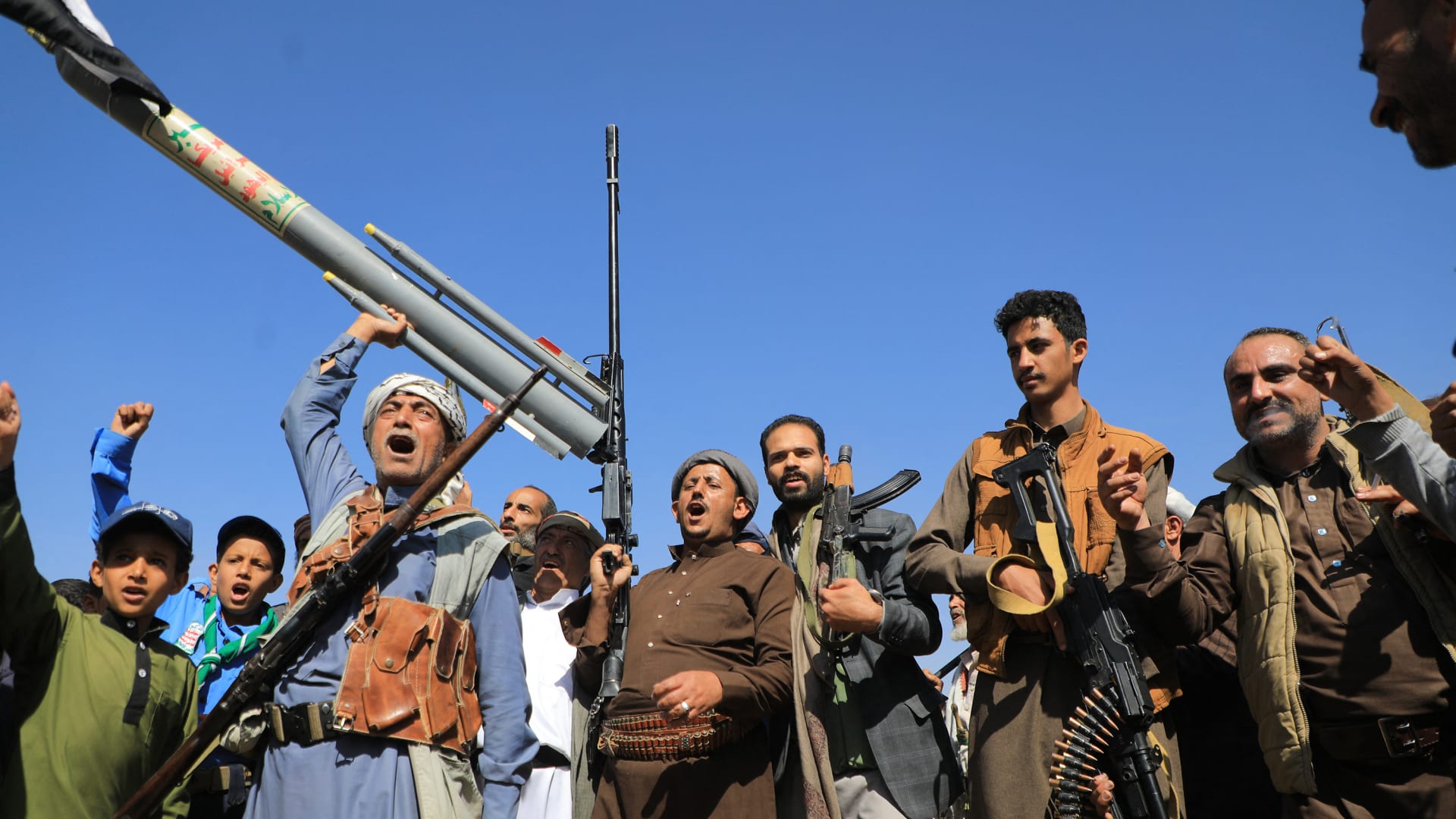
The Houthi group in Yemen, known as Ansar Allah, has declared that it will not remain 'idle' in the face of increasing military escalation in the region. This was stated in an official announcement from the group's Foreign Ministry, which warned that any attempt to broaden the scope of conflict will have serious repercussions on the global economy, supply chains, and oil prices.
The statement emphasized that the escalation by the United States in the region represents a significant 'strategic quagmire,' indicating that Washington seeks to drag new parties into this 'mire.' The group also called on the 'free people of the nation' to unite and coordinate efforts against avenues of external intervention, stressing that free forces will not allow the region to be dragged towards chaos and destruction.
These remarks come at a time when the region is experiencing a dangerous military escalation that began in late February, with the United States and Israel targeting Iranian interests in a series of attacks, resulting in the deaths of several Iranian officials, prompting Tehran to respond with missiles and drones targeting specific locations in Israel and Arab countries.
The Houthi group is considered one of the main members of what is known as the 'Axis of Resistance,' which includes armed factions and military arms in Iraq and Lebanon. Recently, it has emerged, amid rising tensions, as a key force that maintains the right to respond to any attack against it, continuing to assert that it is 'on alert' to face threats directed at it.
The forces associated with the Axis of Resistance rely on a strategy known as 'unity of arenas,' which aims to coordinate military operations against American and Israeli targets in the region. This strategy ensures the safety of international shipping routes in the Red Sea and stability in other areas under greater threat amid the ongoing escalation.
Heightened tensions between regional and international powers place the region in a sensitive position, where regional confrontations could escalate into comprehensive conflict negatively impacting global markets, especially given the significant reliance on oil as a primary energy source. Any escalation in the conflict would mean exacerbating energy crises and prices amid existing challenges.
In a parallel context, major powers are closely monitoring the situation, seeking ways to de-escalate tensions before everyone is engulfed in unforeseen chaos. This clearly indicates that an escalation of military actions could redraw the contours of conflict in a region plagued by crises from all directions.
Historically, the various factions have demonstrated their ability to influence the course of conflict, underscoring that what is happening is not just isolated conflicts but part of larger wars involving multiple regional and international forces, making it difficult to determine the contours of future conflict and its extent.
The Houthi warnings suggest that the region appears on the brink of comprehensive confrontation led by the overlapping actions of several powers in a struggle for influence, necessitating greater vigilance from all parties involved to avoid potential escalation.